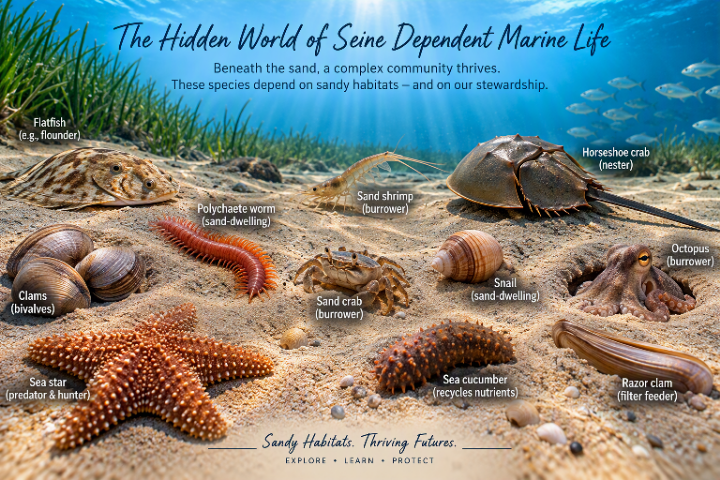
The Hidden World of Sand‑Dependent Marine Life
Sand may seem simple at first glance, but beneath every grain lies an entire living system. From warm tropical shallows to the cold edges of continental shelves, sand forms the foundation of thousands of marine species. Many of these creatures are now threatened, not because of predators, but because their sandy habitats are quietly vanishing. Today, I’m writing about this hidden world the one most people never see, yet countless animals depend on.
Sand is far more than crushed rock. It is a dynamic, shifting environment shaped by waves, storms, currents, and biological activity. Every grain plays a role in supporting life above and below the seafloor. Angelsharks flatten themselves beneath it, leaving only their eyes exposed as they wait for prey to pass. Horseshoe crabs migrate to sandy shores to lay millions of eggs, trusting the sediment to protect the next generation. Sea turtles return to the same beaches year after year, relying on warm, stable sand to incubate their nests. Even tiny sand lances dive headfirst into soft grain beds to escape predators, disappearing in an instant. Sand is not passive; it is an active ecosystem that shelters, feeds, and protects.
To understand why sand matters, it helps to understand what an ecosystem actually is. An ecosystem is a community of living organisms interacting with each other and with their physical environment. Sand qualifies as an ecosystem because it contains oxygen pockets between grains, moisture that supports microbial life, and organic particles that serve as food. It shifts and moves, creating tunnels, burrows, and hiding places. It even contains its own microscopic world bacteria, fungi, protozoa, and viruses collectively known as meiofauna. These microorganisms break down organic matter, recycle nutrients, and support the base of the benthic food web. Without them, the sand would become sterile and lifeless, unable to support the animals that depend on it.
Sand also contains food. Organic particles, decaying plants, plankton remains, and microscopic algae settle into the sediment, forming a buffet for detritivores like sea cucumbers, polychaete worms, and small crustaceans. Many animals feed directly from the sand, sifting through grains to find nutrients. To them, sand is not just a place to hide it is a place to eat. Even octopuses interact with sand ecosystems. While not all octopus species rely on sand, many shallow‑water species bury themselves in sand to hide from predators, lay eggs in sandy crevices, or hunt small prey that lives beneath the grains. Sand provides camouflage, hunting opportunities, and protection for these intelligent cephalopods. In some regions, octopuses build temporary dens in sandy areas, arranging shells and rocks around their chosen spot. Sand is not their primary habitat, but it is an important part of their survival strategy.Angelsharks depend on loose sediment for camouflage and ambush hunting. Without soft, oxygenated sand, they lose both their protection and their ability to feed. Horseshoe crabs rely on sandy intertidal zones to spawn, and their eggs become a vital food source for migratory birds. Sea turtles depend on sand for nesting, and the temperature of that sand determines the sex of their hatchlings. Sand lances, small but essential forage fish, rely on soft grain beds for roosting and predator avoidance.
These species do not simply use sand they are tied to it. Their survival is woven into its texture, temperature, and movement. Yet the sand they depend on is disappearing. Industrial sand mining and dredging have become some of the most destructive forces in coastal environments. Sand is now the world’s most extracted solid resource, and massive dredgers vacuum the seafloor, removing entire benthic communities in minutes. Burrowing habitats collapse, camouflage zones vanish, and egg‑laying sites are destroyed. Coastal armoring seawalls, jetties, and dams traps sediment before it reaches the ocean. Without fresh sand, beaches shrink, grain sizes change, and nesting sites become unstable or unusable.
Pollution adds another layer of danger. Microplastics sink into sand like poison, embedding themselves in sediment where worms, clams, and other sand‑dwelling species ingest them. These toxins move up the food web, affecting larger animals that feed on benthic life. Climate change accelerates the crisis. Rising seas, stronger storms, and shifting currents reshape sand faster than species can adapt. Sand bars wash away, beaches erode, and burrowing zones destabilize. Even slight changes in grain size can make sand unsuitable for species that depend on precise conditions to dig, hide, or nest.
Sand matters more than most people realize. It controls oxygen flow for buried animals, regulates temperature for sea turtle nests, supports food webs through forage fish and invertebrates, and protects coastlines from erosion. Sand even stores carbon, burying organic matter that contributes to long‑term carbon sequestration. When sand ecosystems collapse, the effects ripple outward impacting predators, prey, migratory species, and entire coastal communities.
Protecting sand requires rethinking how we manage coastlines. Marine Protected Areas can shield sandy habitats from dredging and trawling. Living shorelines can replace hard seawalls, allowing sand to move naturally again. Sediment management reforms can restore beaches that turtles and horseshoe crabs depend on. Reducing microplastic pollution protects benthic species from toxic sediment.
Community science projects that monitor nests, erosion, and beach health help ensure these habitats remain viable. The ocean’s most important worlds are often the ones we never see. Sand feels simple, but it holds entire ecosystems together. It protects ancient species, feeds migrating birds, shelters newborn turtles, hides predators waiting for the perfect moment, and supports microscopic life that keeps the ocean functioning. Sand is the quiet foundation of life beneath the waves. And if we protect it, we protect everything that depends on it ensuring these hidden worlds remain alive for generations to come.
References
NOAA. (2023). Benthic habitats and marine sediment dynamics. National Oceanic and Atmospheric Administration. https://www.noaa.govUSGS. (2022).
Coastal sediment transport and shoreline change. United States Geological Survey. https://www.usgs.govIUCN. (2023).
The IUCN Red List of Threatened Species: Angelshark, Horseshoe Crab, Sea Turtles. International Union for Conservation of Nature. https://www.iucnredlist.org
Marine Biological Association. (2021). Meiofauna biodiversity in marine sands. Marine Biological Association of the United Kingdom. https://www.mba.ac.ukSmithsonian Institution. (2020).
Sea turtle nesting ecology. Smithsonian Ocean Portal. https://ocean.si.eduWoods Hole Oceanographic Institution. (2022).
Sand lance ecology and predator–prey dynamics. WHOI Research Highlights. https://www.whoi.eduRochman, C. M., et al. (2013).