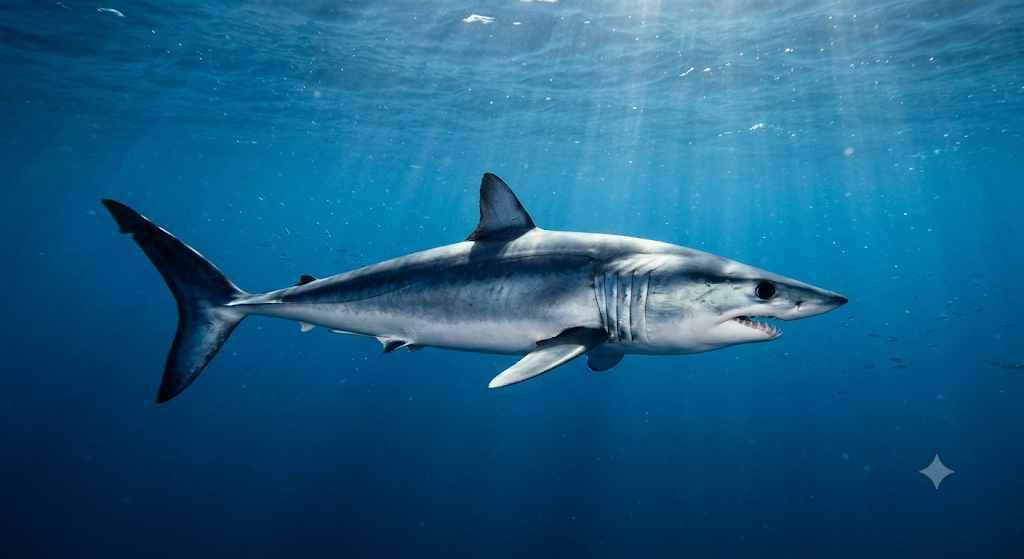
The Shortfin Mako — The Ocean’s Lightning
The shortfin mako is the ocean’s lightning strike a shark built for speed, precision, and long‑distance wandering. Everything about this animal feels electric. Even when it’s perfectly still, a mako carries the tension of something ready to launch. If the great white is the heavyweight of the sea, the mako is the sprinter, a creature so fast and so finely engineered that the water seems to bend around it.
Makos live in the open ocean, far from the safety of reefs or coastlines. Their world is the pelagic blue endless, deep, and without boundaries. They roam through the Atlantic, Pacific, Indian Ocean, and even the Mediterranean, following currents, prey migrations, and temperature shifts. A mako doesn’t stay in one place. It travels thousands of miles a year, crossing entire ocean basins with the confidence of a creature built for the journey.
They are medium‑sized sharks, but built like athletes. Females can reach ten to twelve feet, males slightly smaller, and the largest individuals weigh close to a thousand pounds. Their bodies are tapered and aerodynamic, with muscles packed tight along the spine. Their eyes are large and alert, always calculating. When a mako turns, it doesn’t arc it snaps, pivoting with a kind of athletic grace that looks impossible for a creature its size.
Makos are the fastest sharks in the world. Scientists have recorded speeds over forty‑five miles per hour, but numbers don’t capture the reality. What you see is a blur, a flash of silver, a sudden absence where a fish used to be. Their prey tuna, mackerel, swordfish, squid are fast themselves, but the mako is faster. Much faster. They hunt with explosive bursts, sudden acceleration, and tight turns that leave almost no chance for escape.
Despite their power, makos are not reckless. They are curious, bold, and intelligent. Divers often describe them as confident and aware, circling just close enough to observe. You can feel the thinking behind their movements a predator that makes decisions, not just reactions. Makos do not eat whales. They may occasionally scavenge a carcass, but they are not whale hunters. Their diet is built around speed: fast fish, fast squid, fast chases. And while they are formidable, adult makos have almost no natural enemies. Only the largest sharks or an occasional killer whale pose a threat, and even those encounters are rare.
In the wild, the mako is a master of its domain. They travel alone. Makos are solitary wanderers, moving through the open ocean with no need for packs or pods. Sometimes several may gather around abundant prey, but they do not cooperate or stay together afterward. Their lives are lived independently, guided by instinct, temperature, and the invisible highways of the sea. To watch a mako is to witness the ocean’s engineering at its finest. Every fin, every muscle, every movement is optimized for survival in a world without limits. They are the embodiment of motion the ocean’s fastest traveler, a creature that reminds us how wild and extraordinary the open sea truly is.
Sources & Further Reading:
For readers who want to explore the biology and behavior of the shortfin mako shark, several reputable scientific and educational resources provide detailed information. The NOAA Fisheries Species Profile offers an overview of mako shark habitat, diet, migration patterns, and pelagic behavior at:
https://www.fisheries.noaa.gov/species/shortfin-mako-shark (fisheries.noaa.gov)
Smithsonian Ocean Portal at:
https://ocean.si.edu/ocean-life/sharks-rays/shortfin-mako-shark (ocean.si.edu)
Florida Museum of Natural History provides a detailed species account at:
https://www.floridamuseum.ufl.edu/discover-fish/species-profiles/isurus-oxyrinchus (floridamuseum.ufl.edu)
The Guy Harvey Research Institute also offers mako tagging maps and migration studies that reveal how far these sharks travel across the open ocean; their research can be explored at: https://ghri.nova.edu.