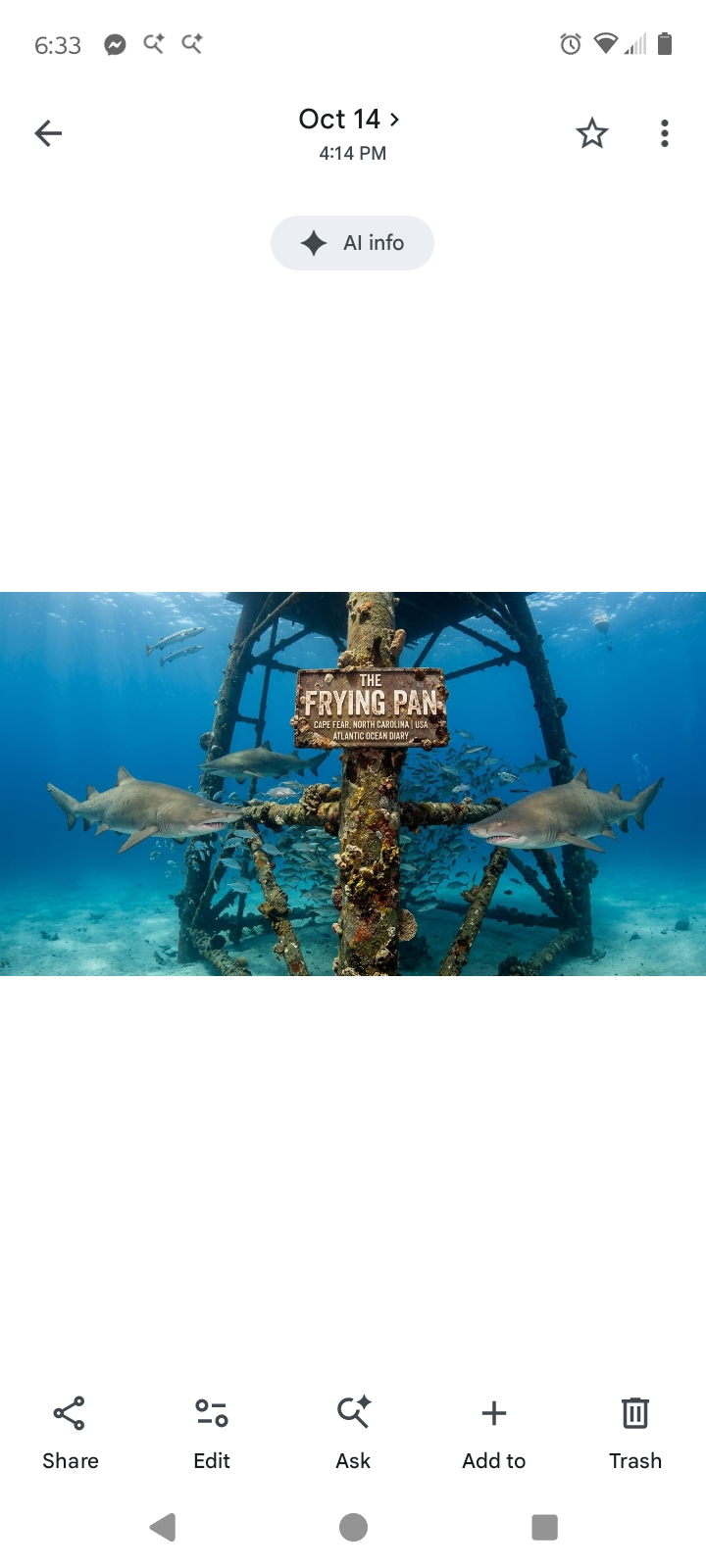
It all started with a little homework blunder. Recently, I had an assignment for my marine biology class that required me to observe a live ocean camera for 30 minutes, taking notes on species diversity, vertical zonation, and ecological dynamics. I settled in, opened up the live camera feed for the Frying Pan Tower off the coast of North Carolina, and was completely mesmerized. I watched Sand Tiger Sharks gliding gracefully past encrusted steel pylons, schools of baitfish darting through the light rays, and barracudas hovering in the open current. After half an hour of taking detailed field notes, I went back to re-read the submission guidelines only to realize I had read the prompt completely wrong! The assignment specifically required us to observe a stream from a public aquarium, not an unmanaged, open-ocean tower in the wild.
Even though I had to start over with an aquarium feed for my actual grade, the time I spent watching Frying Pan Shoals was too fascinating to let go. So, I decided to turn my notes into an entry for the Ocean Diaries!
If you're wondering where this incredible underwater window is located, Frying Pan Tower sits 34 miles out in the open Atlantic Ocean, roughly southeast of Bald Head Island and Cape Fear, North Carolina. Built between 1964 and 1966 by the U.S. Coast Guard, it was originally designed as an offshore light station (resembling a "Texas Tower" oil drilling platform) to warn ships away from the dangerously shallow, shifting sands of Frying Pan Shoals. Decommissioned by the Coast Guard in 2003, the towering structure has undergone incredible preservation and restoration efforts over the years. It even features living quarters and has become a legendary bucket-list destination for adventurous travelers, eco-tourists, and scuba divers brave enough to make the 30+ mile journey offshore.
The true stars of Frying Pan are the Sand Tiger Sharks (Carcharias taurus). Despite their protruding, needle-like teeth, they are slow-moving and remarkably calm. They have a unique biological superpower: they gulp air at the ocean surface and hold it in their stomach, giving them neutral buoyancy so they can hover effortlessly over the seafloor.
The tower creates clear depth layers (zonation). High up in the water column, fast-swimming jacks and spadefish move in tight, defensive schools. Lower down near the sandy bottom, Sand Tigers and stingrays cruise along the shelter of the structural pylons.
In the open ocean, structure equals safety and food. The barnacle- and sponge-covered legs provide substrate for smaller organisms, which draws in small fish, which in turn attracts apex predators—a complete food web in a single camera frame.
Fun Facts About Frying Pan Tower
It’s one of the most remote places you can stay in the U.S. Guests must travel by boat or helicopter.
The tower sits above one of the most dangerous shoals on the East Coast, responsible for hundreds of shipwrecks over the centuries.
It has survived multiple hurricanes, including Florence and Dorian, thanks to its steel legs anchored deep into the seabed.
The live cam often captures sharks, barracuda, sea turtles, jellies, and massive schools of baitfish, depending on season and currents.
The structure acts like an artificial reef, supporting a thriving ecosystem in an otherwise open, sandy expanse of ocean.
Volunteers help maintain the tower, making it one of the few crowd-supported offshore conservation structures in the world.
Recently, I watched a YouTube video of a group of guys who actually stayed overnight at Frying Pan Tower. They were having the time of their lives climbing around the structure, laughing, and even playing on the swing that hangs underneath the tower. At one point, one of them dipped down toward the water, and his buddy had to pull him back up. Suddenly he shouted, “Oh man, there’s a shark!”What he didn’t realize is that the single shark he saw was nothing compared to what’s really down there.
After watching the live cam myself, seeing dozens of Sand Tiger Sharks cruising calmly beneath the tower, I couldn’t help but think: If he had seen what I saw on that camera the sheer number of sharks gliding around those pylons he probably would’ve reconsidered dipping into the water on that swing it’s funny how different the ocean looks when you’re dangling above it versus when you’re quietly observing it through a lens.
Check out the Frying Pan by visiting:https://www.fptower.org/live-cams The site offers information about it’s story, a blog site and donations.
Sometimes a happy accident leads to the best discoveries. While Frying Pan Tower didn't count for my class assignment, watching this wild Atlantic oasis in real time was a great reminder of how artificial structures can become vital marine habitats and how much wonder is waiting just beneath the surface. Have you tuned into the Frying Pan live feed before? Or would you ever dare to stay 34 miles out to sea at an offshore tower?
https://explore.org/livecams/meditation/shark-cam this is where I watched, along with many other live cameras of marine life.