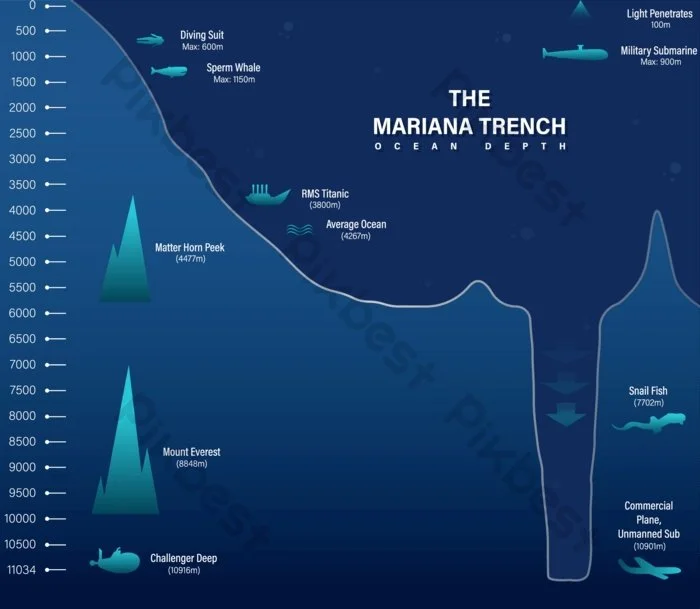
The Mariana Trench — Earth’s Deepest Mystery
References:
- National Oceanic and Atmospheric Administration (NOAA) — Exploring the Mariana Trench
- Smithsonian Ocean Portal — Life in the Deep Sea
- National Geographic — Journey to the Challenger Deep
- Woods Hole Oceanographic Institution — Deep‑Sea Discoveries and Hadal Zone Research
- Cameron, J. (2012). Deepsea Challenger Expedition Reports
- Vescovo, V. (2019). Five Deeps Expedition Findings
Fun and Fascinating Facts:
- Pressure at the bottom is over 1,000 times that at sea level — equivalent to the weight of 50 jumbo jets stacked on you.
- A dropped rock would take about an hour to reach the bottom.
- The trench is 2,550 km long but only 69 km wide — like a scar stretching across an ocean.
- The temperature stays just above freezing, yet life persists.
- We’ve explored less than 5% of the ocean floor — meaning the trench still hides secrets.
- The trench is so deep that if you placed Mount Everest inside it, the peak would still be over a mile underwater.
Famous Dives:
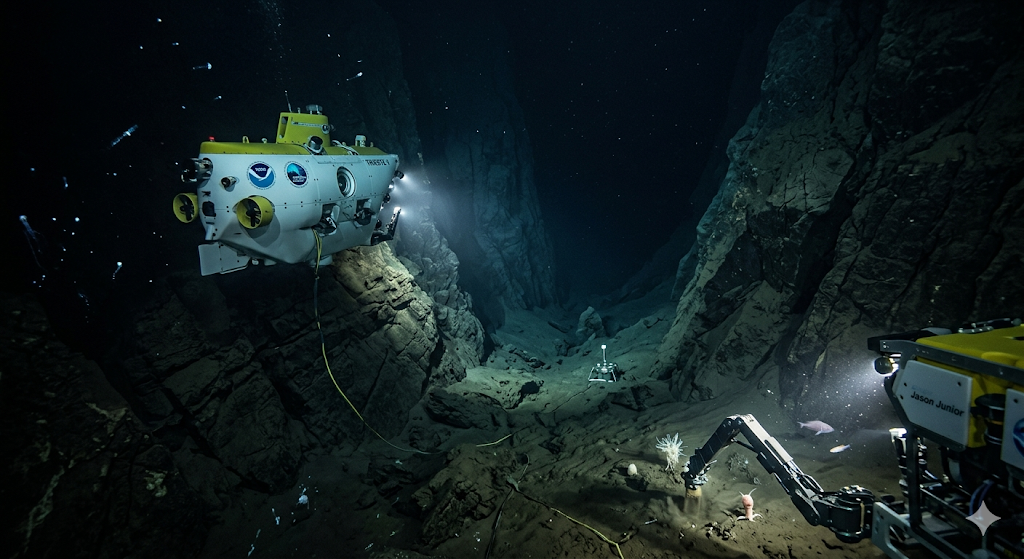
- 1960: Trieste reached the bottom — the first humans to ever see Challenger Deep.
- 2012: James Cameron descended solo in Deepsea Challenger.
- 2019: Victor Vescovo reached the deepest point multiple times, discovering new species and mapping the trench with high‑resolution sonar.
The Descent Begins:
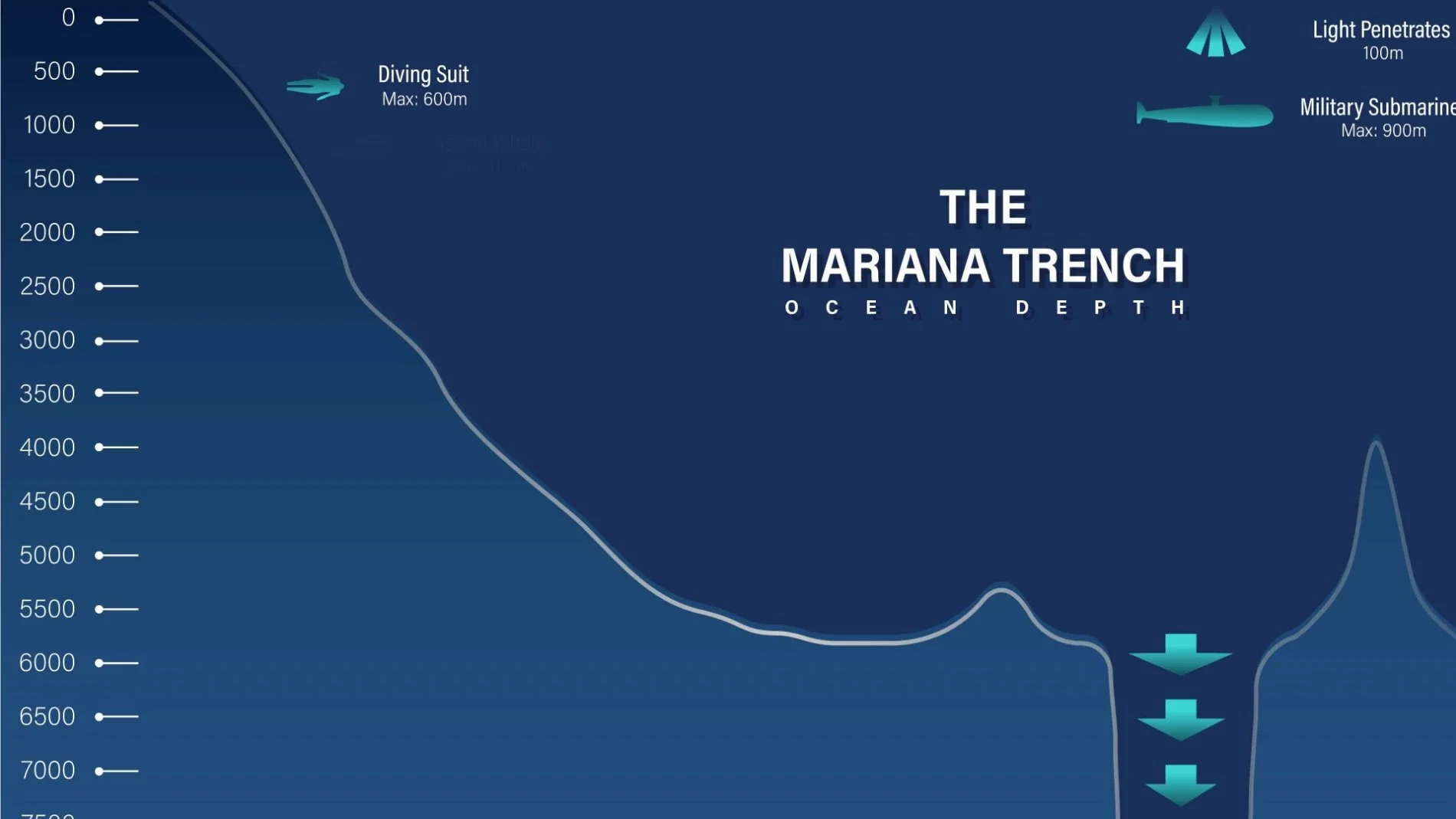
East of the Mariana Islands in the western Pacific lies the Mariana Trench, Earth’s deepest known point. It formed where the Pacific Plate dives beneath the Philippine Plate, creating a narrow, crescent‑shaped scar nearly 10,935 meters (35,876 feet) deep — deeper than Mount Everest is tall. It’s a place where sunlight fades, pressure crushes, and life still finds a way.
A Brief History of Discovery
- First charted: 1875
- By: The British ship HMS Challenger
- How: A weighted rope was dropped overboard, and sailors waited until it hit bottom
- Depth recorded: 8,184 meters — astonishing for the time
The trench was later named after the Mariana Islands, which themselves were named for Spanish Queen Mariana of Austria.
Modern sonar and submersibles revealed the true depth: Challenger Deep, named in honor of the ship that first measured it.
The Depth Zones
| Zone | Depth | Temperature | Pressure | Life |
|------|--------|--------------|-----------|------|
| Epipelagic (Sunlight Zone) | 0–200 m | ~24°C (75°F) | 1 atm | Sea turtles, reef fish |
| Mesopelagic (Twilight Zone) | 200–1,000 m | ~4°C (39°F) | 100 atm | Lanternfish, squid |
| Bathypelagic (Midnight Zone) | 1,000–4,000 m | ~2°C (36°F) | 400 atm | Deep-sea jellyfish, anglerfish |
| Abyssopelagic (Abyssal Zone) | 4,000–6,000 m | ~1°C (34°F) | 600 atm | Tripod fish, sea cucumbers |
| Hadal Zone (The Trenches) | 6,000–11,000 m | ~1–2°C (34–36°F) | 1,100 atm | Amphipods, snailfish |
At the bottom lies Challenger Deep, the deepest known point on Earth — a silent world of pressure and persistence.
What’s Been Found Down There:
The Ghostly Snailfish
The deepest‑living fish ever recorded — a delicate, translucent snailfish — thrives at depths over 8,000 meters.
Its bones are reduced, its body is soft, and it survives pressure that would crush a submarine.
Amphipods With Superpowers
Tiny crustaceans called amphipods live in the trench, and their bodies contain aluminum gel absorbed from seawater — a natural pressure shield.
Microbes That Eat Rocks
Scientists found microbes living inside the trench’s rocks, feeding on chemical energy instead of sunlight.
Some may resemble early life on Earth.
Human Footprints
Shockingly, even here, researchers found:
- Plastic bags
- Candy wrappers
- Microplastics inside amphipods
The deepest place on Earth is not untouched.
Reflection
The Mariana Trench is a reminder that Earth’s greatest mysteries aren’t in space — they’re beneath our feet, in the silent dark.
It’s a world of pressure, patience, and persistence.
A place where life bends but doesn’t break.
And a reminder that even the deepest places carry traces of us — for better or worse.