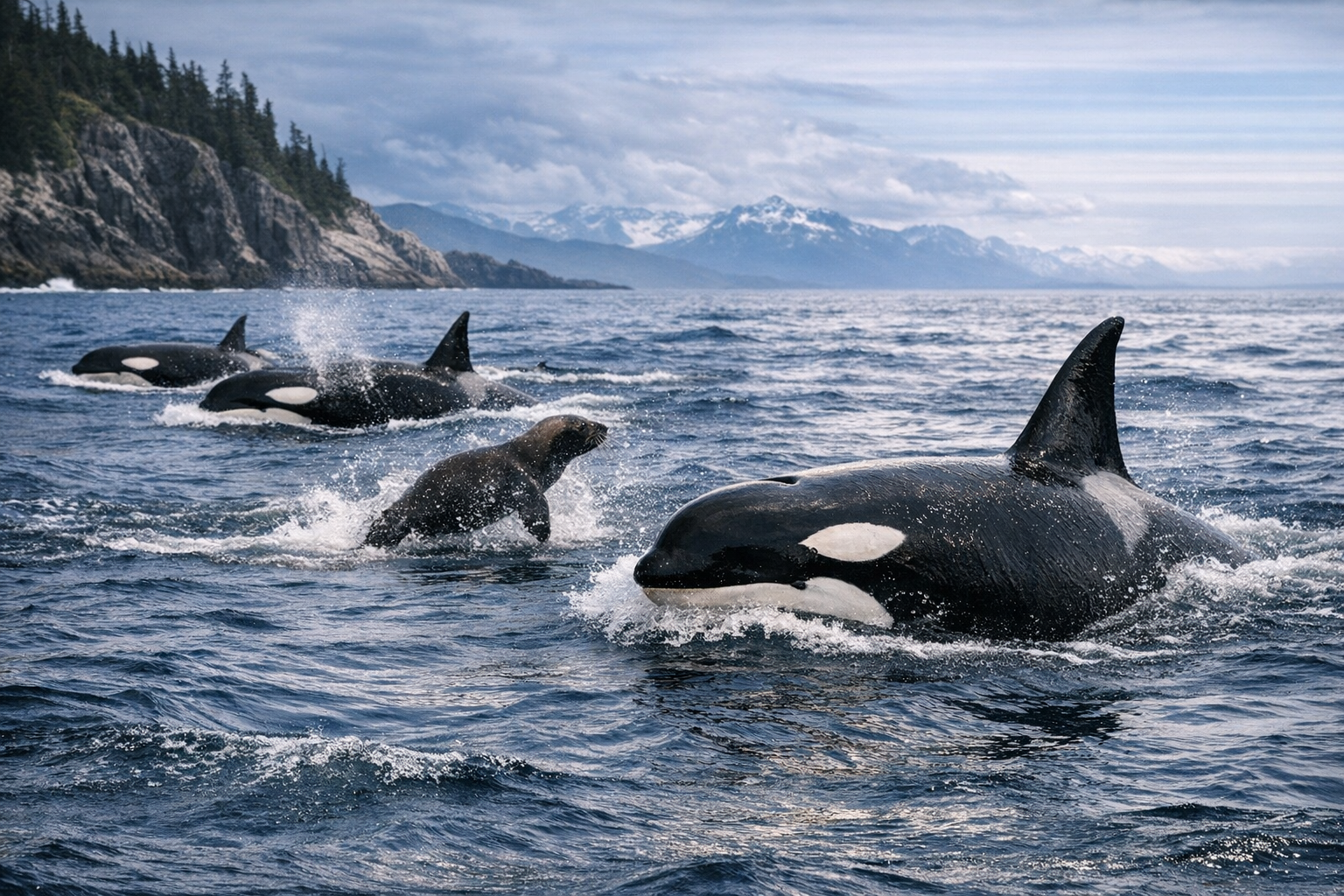
Part II: Transient Orcas (Bigg’s)Silent hunters of the coastal Pacific.
Transient orcas — officially known as Bigg’s killer whales — are the marine‑mammal‑eating ecotype of the North Pacific. They move quietly along the coasts of Alaska, British Columbia, Washington, Oregon, and California, hunting seals, sea lions, porpoises, and even large whales. Their world is defined by stealth, strategy, and fluid social groups that differ sharply from the stable family pods of Resident orcas.
Where Transient Orcas Live
Bigg’s orcas range widely along the eastern North Pacific coastline, from southeast Alaska down to central California (NOAA Fisheries, 2024).
Unlike Residents, they do not stay in predictable home ranges. Instead, they travel long distances following prey availability.
Their movements are:
- coastal
- wide‑ranging
- often unpredictable
- tied to marine‑mammal hotspots
This mobility is one reason their population has been steadily increasing.
What Makes Transients Unique:
1. They Are Silent Hunters
Bigg’s orcas avoid using echolocation while hunting because marine mammals can hear it.
Instead, they rely on:
- stealth
- long surface intervals
- coordinated ambush strategies
This “acoustic camouflage” is one of their defining traits (Ford et al., 1998).
2. They Eat Marine Mammals
Their diet includes:
- harbor seals
- sea lions
- harbor porpoises
- Dall’s porpoises
- gray whale calves
- minke whales
- occasionally seabirds
This high‑calorie diet supports strong growth and reproduction.
3. Their Social Groups Are Small and Fluid
Unlike Residents, who stay with their mothers for life, Transients travel in:
- small groups of 2–7
- temporary associations
- mother‑centered units that may split for long periods
These flexible groups allow them to hunt quietly without drawing attention.
4. They Have Distinct Genetics and Dialects
Bigg’s orcas are genetically and culturally separate from Residents (Morin et al., 2010).
Their vocalizations are:
- sparse
- simple
- used mostly after a kill
This reduces the chance of alerting prey.
Population Trends
Bigg’s orcas are one of the few killer whale populations in the world that are increasing.
Their numbers have grown steadily due to:
- abundant seal and sea lion populations
- flexible diet
- wide range
- strong calf survival rates
As of 2024, the population is estimated at over 400 individuals across the eastern North Pacific (NOAA Fisheries, 2024).
Interesting Facts About Transient Orcas
- They can take down gray whale calves in coordinated attacks lasting hours.
- They often share prey, especially within mother‑offspring groups.
- They travel silently for long stretches, surfacing without vocalizing.
- They can appear suddenly in areas where they haven’t been seen for months.
- Their dorsal fins are often straighter and pointier than Resident orcas.
- They avoid Residents entirely — the two ecotypes do not mix.
Why Transients Matter
Bigg’s orcas play a crucial role in coastal ecosystems by regulating marine‑mammal populations. Their recovery reflects the rebound of seals and sea lions after the Marine Mammal Protection Act.
Their story is one of resilience — a population thriving through adaptability, stealth, and a hunting strategy unlike any other orca on Earth.
References
Ford, J. K. B., Ellis, G. M., & Balcomb, K. C. (1998). Killer Whales: The Natural History and Genealogy of Orcinus orca in British Columbia and Washington State.
https://www.pacificwhale.org
Morin, P. A., et al. (2010). Complete mitochondrial genome phylogeographic analysis of killer whales. Genome Research.
https://genome.cshlp.org
NOAA Fisheries. (2024). Bigg’s (Transient) Killer Whales: Biology, Range, and Population Trends.
<u>https://www.fisheries.noaa.gov/species/false-killer-whale
Further Reading
DFO Canada — Bigg’s Killer Whales
https://www.pac.dfo-mpo.gc.ca
Marine Mammal Science Journal — Orca Predation Studies
https://marinemammalscience.org
Orca Network — Sightings & Identification
<u>https://www.orcanetwork.org
The Whale Museum — Bigg’s Orca Education
https://whalemuseum.org
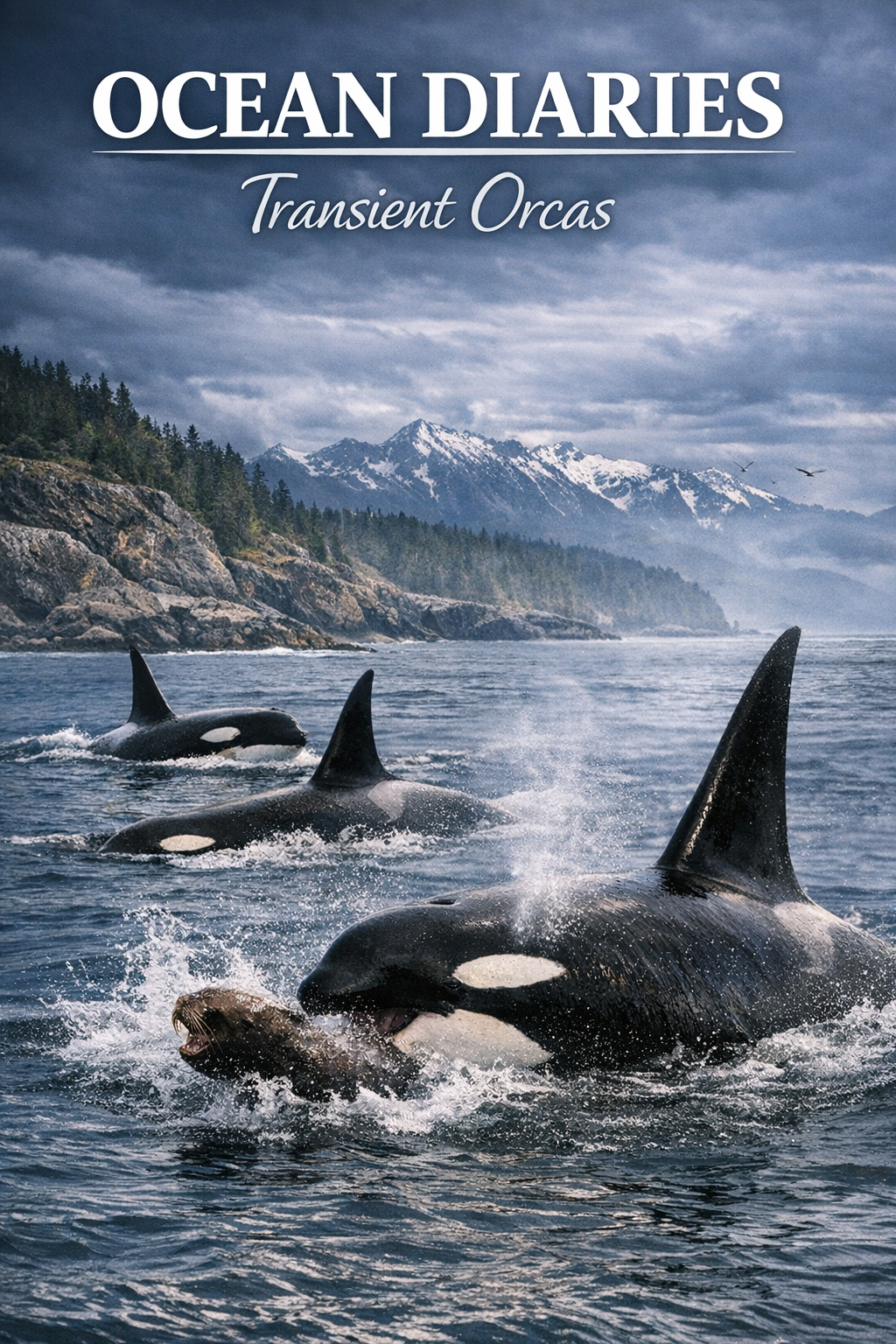
Why Are Transient Orcas Called “Bigg’s”?
They’re named after the scientist who proved they were a separate ecotype.
Transient orcas are often called Bigg’s killer whales in honor of Dr. Michael A. Bigg, the Canadian marine biologist who revolutionized orca research in the 1970s. Bigg developed the first photo‑identification system for killer whales, allowing scientists to track individuals by their dorsal fins and saddle patches (Bigg, 1982).
Before his work, people thought all orcas were the same. Bigg’s research proved that Transients:
- eat marine mammals, not fish
- travel in small, stealthy groups
- have different vocal patterns
- avoid Resident orcas entirely
This was groundbreaking — it showed that killer whales have distinct cultures and ecotypes, not just different diets (Ford & Ellis, 1999).
- (Bigg, 1982)
- (Ford & Ellis, 1999)
- (Ford et al., 1998)
- (NOAA, 2024)
More Fun, Science‑Backed Bigg’s Orca Facts:
1. They hunt in silence
Unlike Residents, Bigg’s orcas stay quiet while hunting so seals and porpoises can’t hear them coming (Ford et al., 1998).
2. Their population is growing
Because marine‑mammal prey like seals and sea lions have rebounded, Bigg’s orcas are one of the few orca populations currently increasing (NOAA, 2024).
3. They travel huge distances
Bigg’s orcas can cover hundreds of miles along the Pacific coast, from California to Alaska, following prey migrations (NOAA, 2024).
4. They form flexible social groups
Instead of tight family pods like Residents, Bigg’s orcas form fluid alliances, sometimes joining up with other groups temporarily (Ford & Ellis, 1999).
5. They specialize in marine mammals
Their diet includes:
- harbor seals
- sea lions
- porpoises
- dolphins
- occasionally small whales
This high‑calorie diet supports their powerful, stealth‑based hunting style.
Quick Facts
- Ecotype: Transient (marine‑mammal‑eating)
- Alternate Name: Bigg’s killer whales
- Range: Entire West Coast — California to Alaska
- Population Trend: Increasing due to seal and sea lion recovery (NOAA, 2024)
- Group Size: Small, flexible groups of 2–7
- Hunting Style: Silent, stealth‑based predation (Ford et al., 1998)
- Primary Prey: Seals, sea lions, porpoises, dolphins
- Vocal Behavior: Quiet while hunting; burst calls after kills
- Social Structure: Fluid alliances, not tight family pods (Ford & Ellis, 1999)
Why They Stand Out
Bigg’s orcas are one of the few orca populations thriving today, thanks to abundant marine‑mammal prey and their adaptable hunting strategies (NOAA, 2024).