Part I: Resident Orcas
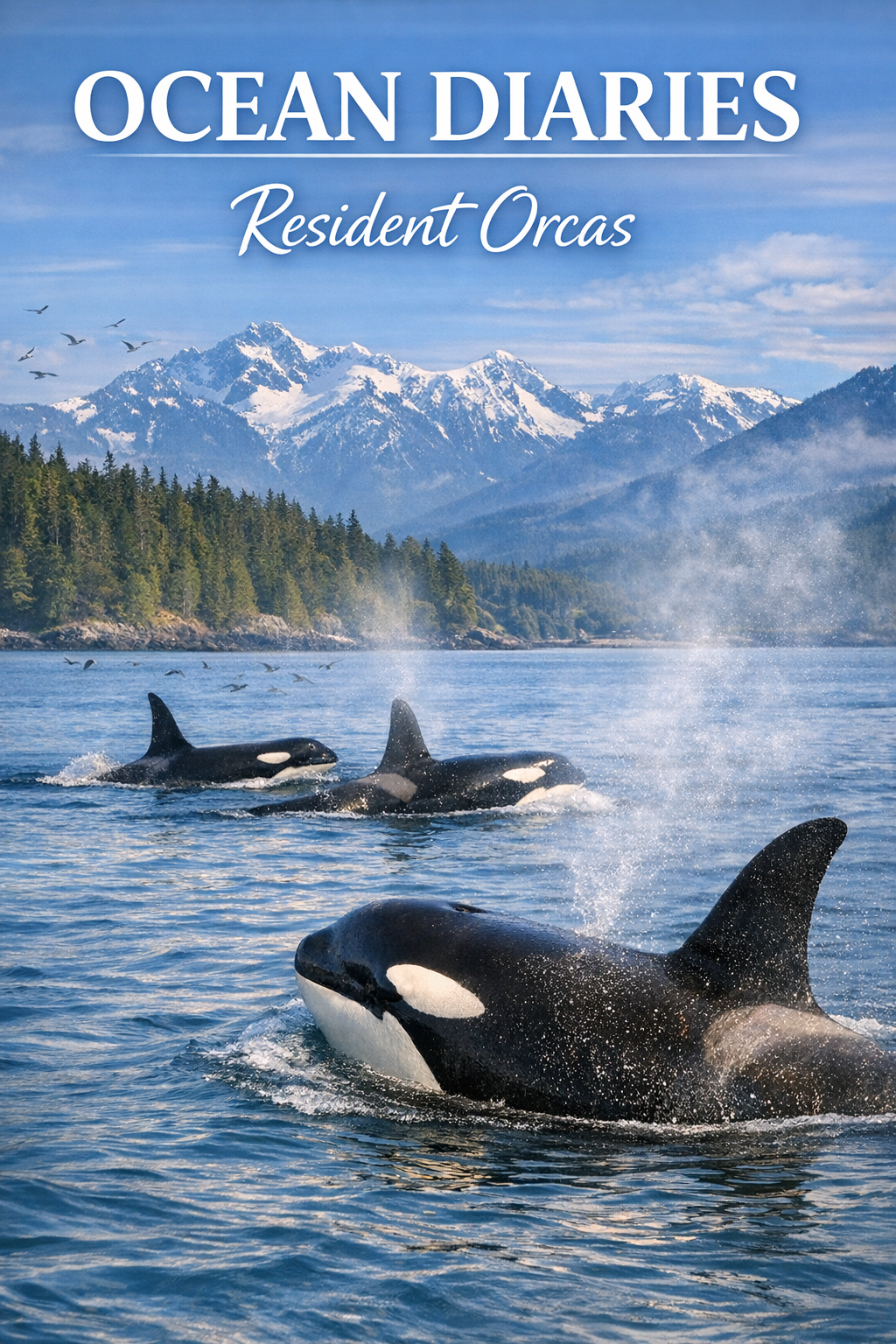
A look into the culture, habitat, and science of the North Pacific’s fish‑eating killer whales.
Resident orcas are one of the most studied and culturally rich populations of killer whales on Earth. Unlike their mammal‑eating relatives, Residents are defined by their stable family groups, salmon‑based diet, and complex vocal traditions that pass from generation to generation. Their story is one of deep cultural continuity, long‑term scientific discovery, and a future shaped by the health of the coastal ecosystems they depend on.
Where Resident Orcas Live
Resident orcas inhabit the eastern North Pacific, ranging from Alaska down through British Columbia, Washington, and Oregon (NOAA Fisheries, 2024).
They are divided into three major communities:
- Alaska Residents
- Northern Residents (primarily British Columbia)
- Southern Residents (Washington, BC, Oregon)
Each community has its own pods, matrilines, and dialects, forming distinct cultural groups even within the same species.
What Makes Residents Unique
1. They Are Fish Specialists
Residents primarily eat salmon, especially Chinook, which is their highest‑calorie prey (Hanson et al., 2021).
An adult Resident orca requires 200–385 pounds of fish per day, depending on age, sex, and season (NOAA Fisheries, 2024).
2. They Live in Stable Family Pods
Resident orcas live in matrilineal societies, meaning both sons and daughters stay with their mothers for life (Center for Whale Research, 2023).
Pods are made up of:
- A matriarch (often 60–90+ years old)
- Her offspring
- Her daughters’ offspring
- Multiple generations traveling together
These family bonds are among the strongest recorded in any marine mammal.
3. They Have Distinct Dialects
Each Resident pod uses a unique set of calls — dialects — that are learned, not genetically inherited (Ford, 1991).
These dialects act like cultural signatures, allowing researchers to identify pods by sound alone.
4. They Do Not Hunt Marine Mammals
Residents are strictly fish‑eaters, which is why they can safely interact with dolphins and other small cetaceans.
This is also why Northern Residents were recently documented cooperatively hunting with Pacific white‑sided dolphins, a scientific first (UBC Science, 2024).
Southern Residents: The Most Endangered Resident Community
The Southern Resident Killer Whales (SRKW) are the smallest and most threatened Resident population, with only 73 individuals remaining as of 2024 (NOAA Fisheries, 2024).
Major Threats
- Chinook salmon decline — their primary food source
- Noise and vessel disturbance — interferes with hunting and communication
- Toxic contaminants — PCBs and other pollutants stored in blubber
- Entanglement risk — increased by coastal fishing activity
These threats compound over time, affecting reproduction, survival, and cultural continuity.
Interesting Facts About Resident Orcas
- Female orcas can live 80–100+ years, with some documented over a century (CWR, 2023).
- Adult males rely heavily on their mothers; mortality increases after a mother’s death (Foster et al., 2012).
- Residents share food frequently, especially mothers feeding offspring.
- Each Southern Resident belongs to J, K, or L Pod, each with its own history and dialect.
- Northern Residents have been documented in 250+ interactions with dolphins during cooperative hunts (UBC Science, 2024).
The Future of Resident Orcas
The future of Resident orcas depends on:
- Restoring Chinook salmon runs
- Reducing underwater noise
- Protecting coastal habitats
- Long‑term monitoring and research
Their survival is tied to the health of the Pacific Northwest’s rivers, estuaries, and marine ecosystems. Protecting these whales means protecting the entire coastal food web they depend on.
References
Center for Whale Research. (2023). Southern Resident Killer Whale Population Census.
https://www.whaleresearch.com
Ford, J. K. B. (1991). Vocal traditions among Resident killer whales of the Pacific Northwest. Canadian Journal of Zoology.
https://cdnsciencepub.com/doi/10.1139/z91-239
Foster, E. A., et al. (2012). Adaptive benefits of matrilineal living in killer whales. Science.
https://www.science.org/doi/10.1126/science.1219240
Hanson, M. B., et al. (2021). Diet and seasonal foraging patterns of Resident killer whales. NOAA Technical Memorandum.
https://www.fisheries.noaa.gov
NOAA Fisheries. (2024). Southern Resident Killer Whales: Status, Threats, and Recovery.
https://www.fisheries.noaa.gov/species/southern-resident-killer-whale
UBC Science. (2024). Northern Resident Killer Whales and Pacific White‑Sided Dolphins Documented in Cooperative Hunting.
https://science.ubc.ca</
Further Reading
Orca Network — Sightings & Education
https://www.orcanetwork.org
DFO Canada — Northern Resident Killer Whales
https://www.pac.dfo-mpo.gc.ca</
NOAA — Killer Whale Acoustic Research
https://www.fisheries.noaa.gov/west-coast/science-data/killer-whale-acoustics
Marine Mammal Science Journal — Orca Behavior Research
https://marinemammalscience.org
The Whale Museum — Salish Sea Orca Education
<u>https://whalemuseum.org
