Sand Brief: The Land of the Ocean.
Most people think sand is just the stuff that sticks to your feet - background scenery, something you shake out of your shoes. But ocean sand is alive. It breathes, shifts, filters, hides, feeds, and protects. Every grain is a tiny piece of the oceans memory, shaped by what lived, died, and will live again. When we disturb it, we’re not just moving dirt. We’re disrupting an entire world that depends on those shifting grains to survive.
Ocean sand is the first neighborhood of the sea. Before you ever see a wave, before a fish darts past your ankle, before a turtle lifts its head for air, the sand is already working. It’s holding the shoreline in place. It’s filtering water as it moves. It’s sheltering creatures we rarely see, worms, crabs, tiny fish, and the angel shark buried so perfectly that only its eyes give it away. Sand is the ocean’s ground floor, the foundation every other life depends on.
What makes ocean sand different is that it’s constantly in motion. Wave turn it, tides lift it, currents carry it, and every shift creates new hiding places and new feeding grounds. A single square foot of sand can hold more life than an entire backyard garden. It’s a living system, not a backdrop. And when we dig it up, mine it, dredge it, or flatten it for convenience, we erase the homes of species that have survived for millions of years.
Sand is also the ocean’s storyteller. Each grain carries the history of coral, shells, volcanic rock, and ancient reefs. It tells us what the ocean used to be and what it’s losing. When sand disappears, the shoreline weakens, habitats collapse, and the creatures who depend on it, from hatchling turtles to buried sharks, lose their first line of protection.
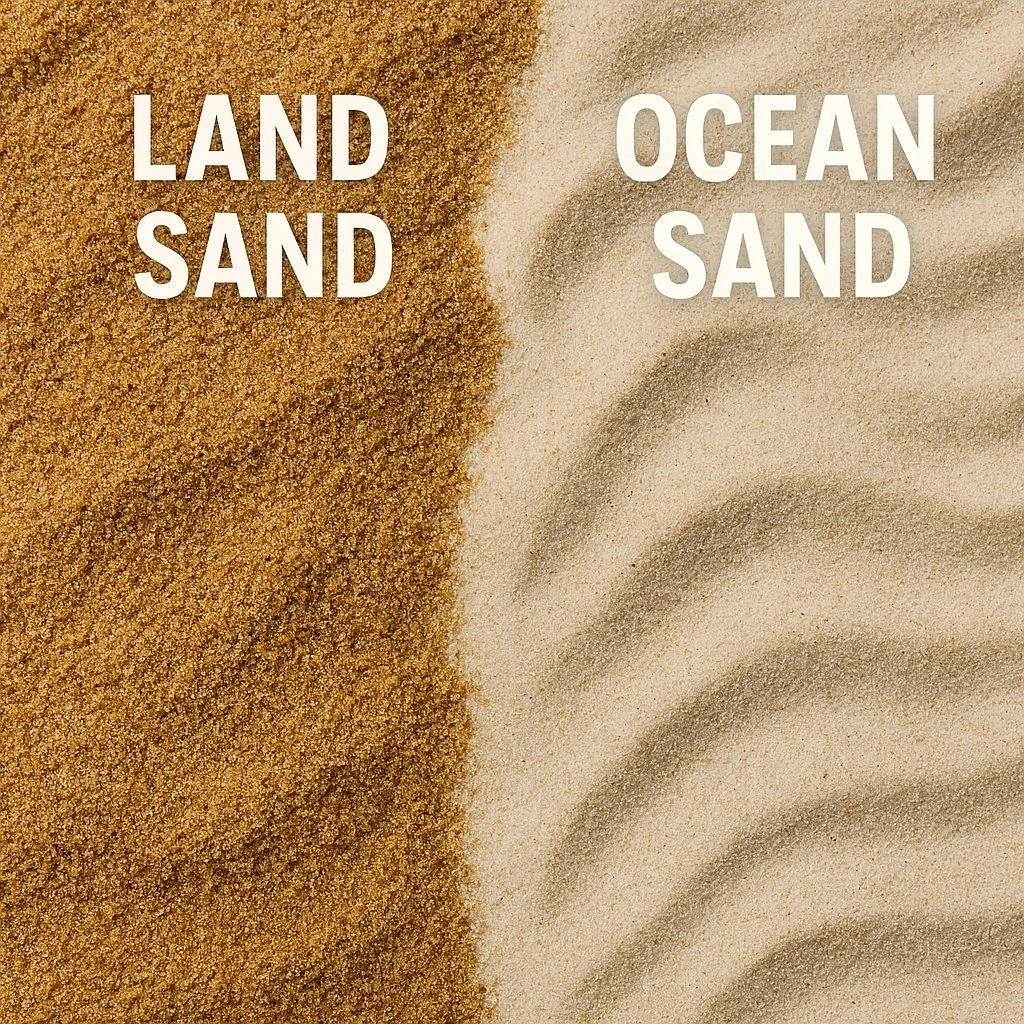
The difference between land sand and ocean sand
This is why sand matters. It’s not decoration. It’s not disposable. It’s the land of the ocean, the place where life begins, hides, grows, and returns. And if we want to protect the ocean, we have to start with the ground beneath it.
Ocean sand is crowded with life. It’s the first shelter, the first hunting ground, and the first nursery for countless species. Angel sharks disappear beneath the grains, using the sand as camouflage to survive and hunt. Crabs build tunnels that protect them and help oxygen move deeper to the shoreline. Turtle hatchlings depend on the sand’s temperature, softness, and slope for their very first steps into the world. Seagrass anchors its roots in the sand, creating meadows that feed and protect entire food webs. Everyone of these creatures needs the sand exactly as it is. Take it away, and their world collapses.
Ocean sand works because it’s built by the ocean. Its grains are shaped by waves, shells, coral, and constant movement. When we replace it with land sand or disturb it too much, the system breaks. Land sand is the wrong shape. Its grains are sharper, heavier, and don’t move the way ocean sand does. It smothers the creatures that need soft, shifting grains to breathe and hide. Buried species die off. Angel sharks, crabs, worms, and tiny fish lose their camouflage and their oxygen flow. Seagrass can’t root. Without the right sand, the meadows collapse, and the food webs that depend on them collapse too. Shorelines weaken. The wrong sand doesn’t hold together under waves, so beaches erode faster and storms hit harder. Changing the sand changes the entire foundation of the ocean.
Sand-it’s the land of the ocean- the place where life hides, grows, hunts, and begins. Protecting sand means protecting everything that depends on it, from the buried shark to the shoreline.
