Dr. Guy Harvey
Dr. Guy Harvey’s story begins long before the research institutes, the conservation foundation, or the world‑famous artwork. It begins with a boy in Jamaica who couldn’t stop staring at the ocean. Growing up surrounded by turquoise shallows and deep blue drop‑offs, Harvey felt drawn to the water in a way that never faded. While other children chased games and noise, he chased fish. He sketched them, studied them, followed them, and asked questions most adults couldn’t answer.
That early curiosity became the foundation of his life’s work. Harvey didn’t choose the ocean because it was beautiful. He chose it because it was alive. It was mysterious. It was full of creatures that deserved to be understood rather than feared. His fascination began with sharks not as monsters, but as misunderstood predators with purpose, intelligence, and grace. He often described sharks as the perfect blend of beauty and biology, and that combination shaped everything he became: an artist, a scientist, a conservationist, a storyteller, and ultimately one of the ocean’s most influential defenders.
Before the research and the tagging programs, Harvey’s first impact came from a pencil. His shark drawings were so detailed and lifelike that people stopped to stare. His art captured the imagination of the public and opened the door to conversations about ocean life, conservation, and the importance of protecting marine species. Art made people care. Science gave them reasons. Harvey used both.
He went on to earn a PhD in fisheries biology, turning passion into expertise. His research focused on the great wanderers of the open ocean tiger sharks, oceanic whitetips, shortfin makos, billfish, and other pelagic species whose lives unfold far from shore. Through the Guy Harvey Research Institute, he helped pioneer satellite tagging programs that revealed the secret migrations of sharks across entire oceans. His work showed how far makos travel, how tiger sharks navigate reefs and open water, how oceanic whitetips roam the high seas, and how vulnerable these species are to overfishing.
These discoveries changed what scientists knew about shark behavior and now guide conservation policy worldwide. Harvey’s legacy extends far beyond research. His foundation supports youth ocean education, habitat restoration, responsible fishing practices, coral reef protection, and marine science scholarships. His artwork funds conservation. His science informs it. His voice amplifies it. His mission has always been simple: protect what you love, teach what you know, and inspire who you can. Today Dr. Guy Harvey stands as a reminder that ocean heroes don’t all come from laboratories or government offices. Some come from childhood curiosity, a sketchbook, and a lifelong promise to defend the sea. He chose the ocean because it chose him first and he spent his life giving back to the place that shaped him.
Sources & Further Reading:
For readers who want to explore Dr. Guy Harvey’s work more deeply, several reputable resources offer insight into his research, artwork, and conservation mission. The Guy Harvey Foundation provides extensive information on current projects, educational programs, and marine conservation initiatives at:
https://guyharvey.com/pages/guy-harvey-foundation (guyharvey.com in Bing).
The Guy Harvey Research Institute, operated through Nova Southeastern University, publishes shark tagging results, migration maps, and scientific updates that highlight Harvey’s contributions to fisheries biology; their research can be found at;
https://ghri.nova.edu. To explore Harvey’s artwork and its role in funding conservation, his official gallery showcases decades of marine illustrations and paintings at:
https://guyharvey.com/pages/art.
Nova Southeastern University also maintains a detailed overview of Harvey’s academic background, research collaborations, and scientific publications at:
https://www.nova.edu/guy-harvey/index.html.
For readers interested in broader shark conservation topics connected to Harvey’s work, the International Union for Conservation of Nature (IUCN) provides species assessments for makos, tiger sharks, oceanic whitetips, and other pelagic predators at:
https://www.iucnredlist.org. Additional context on shark migration and tagging technology can be found through the Save Our Seas Foundation at:
https://saveourseas.com. These sources offer a deeper look at the science, art, and conservation legacy that define Dr. Guy Harvey’s impact on the ocean.
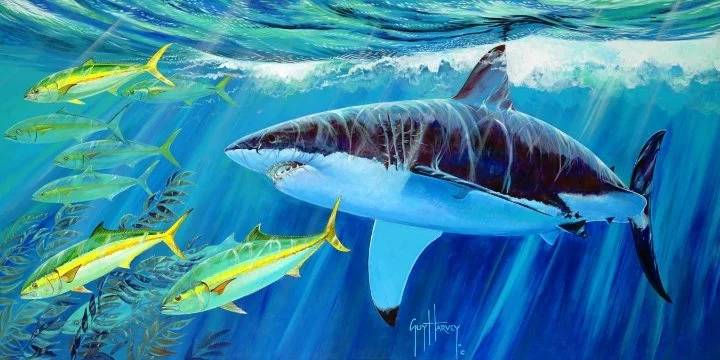
Guy Harvey painting of a Great White
