The Human Cost of Captivity
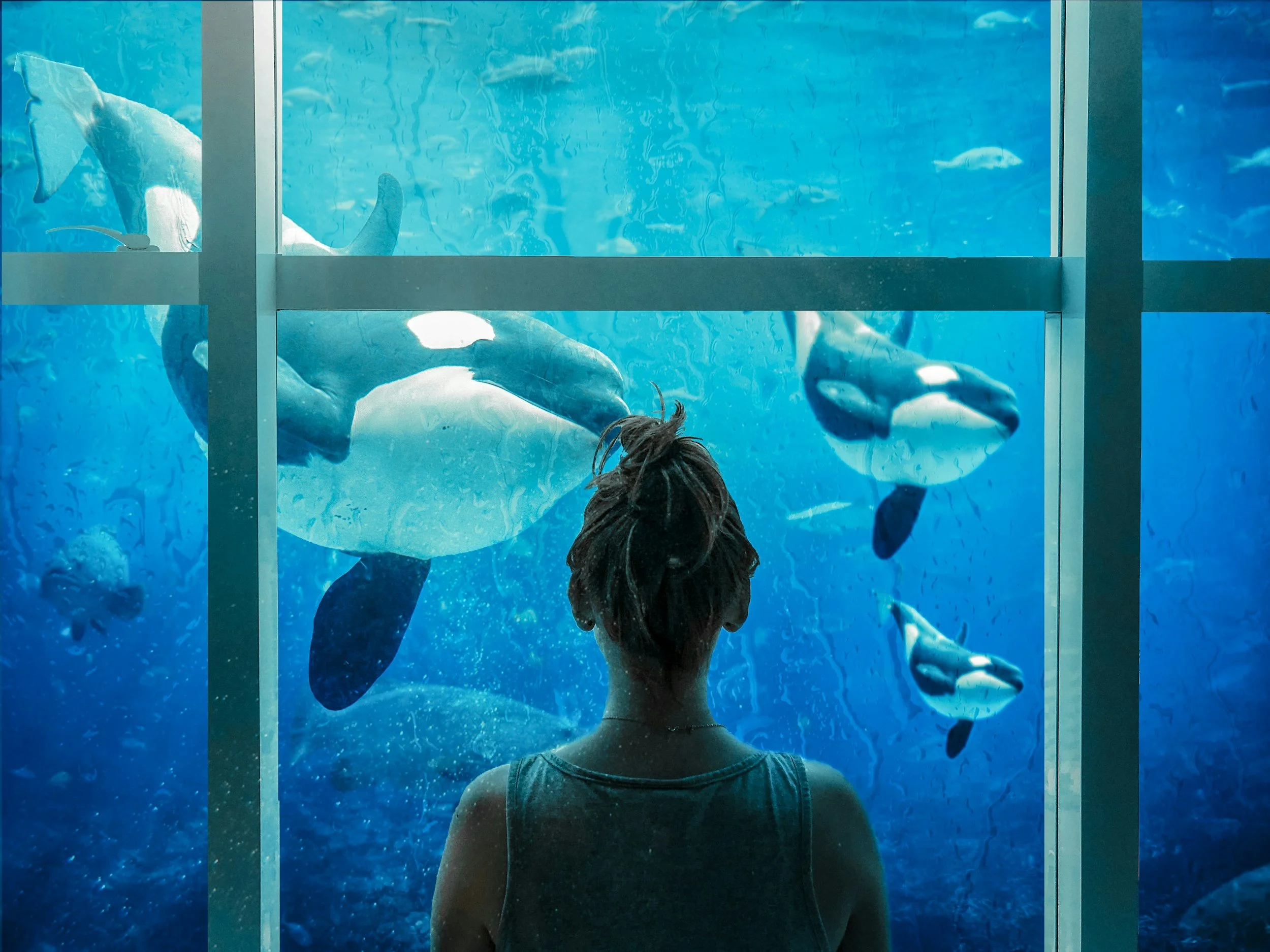
Fight to Save the World’s Most Intelligent Ocean Predators
Orcas are built for the open ocean. They are among the most cognitively advanced predators on Earth, possessing a level of intelligence, emotional depth, and cultural complexity that rivals the great apes. In the wild, their lives unfold across vast territories as they travel up to a hundred miles a day, communicating through distinct dialects and living within tightly knit family pods that remain together for life. Their societies are rich, stable, and generational, shaped by traditions passed down through mothers and grandmothers who lead their pods with memory and experience.
Captivity interrupts all of this. It takes an animal designed for endless ocean and places it inside a concrete tank. More than three thousand cetaceans are held in captivity worldwide, confined to artificial environments that represent only a fraction of their natural range. The consequences are visible in every scientific study: shortened lifespans, collapsed social structures, chronic stress, dental destruction, and psychological trauma that manifests in aggression, self‑harm, and lethargy. Wild orcas routinely live fifty to eighty years; captive orcas often die before twenty. Their bodies deteriorate, their minds fracture, and their cultures disappear.
The world has begun to acknowledge this. In 2019, Canada passed the Ending the Captivity of Whales and Dolphins Act, making it illegal to capture, breed, or display cetaceans for entertainment. Europe has moved toward phase‑outs, and the United States has ended orca breeding and reduced theatrical shows. Public opinion has shifted dramatically, driven by documentaries, scientific research, and the undeniable evidence of suffering. But one nation is moving in the opposite direction. China has rapidly expanded its marine entertainment industry, building dozens of new parks and importing whales from abroad. It is now the largest consumer market for captive cetaceans, sustaining demand even as the rest of the world pulls away. Inside many of these facilities, tanks are overcrowded, veterinary oversight is inconsistent, and breeding programs continue without regard for the long‑term welfare of the animals.
Mortality rates are high, infections are common, and behavioral distress is widespread. China’s refusal to stop has created a new era of captivity, one where suffering is not only maintained but manufactured.This demand fueled one of the most disturbing events in modern marine captivity: Russia’s “whale jail.” Dozens of illegally captured orcas and belugas were held in freezing pens, awaiting shipment to Chinese marine parks. Many developed infections, injuries, and severe stress. They were released only after global outrage forced intervention. The whale jail stands as a stark reminder that captivity is not a relic of the past. It is an active industry, and China is its epicenter.
The consequences of captivity extend beyond the whales themselves. Human lives have been lost inside these facilities. The deaths of trainers such as Dawn Brancheau in 2010, Keltie Byrne in 1991, and Daniel Dukes in 1999 were not random accidents. They were the predictable result of confining a highly intelligent predator in an environment that destroys its psychological stability. When an orca’s mind fractures under stress, the danger extends to everyone around it. These tragedies underscore a truth that cannot be ignored: captivity harms whales, but it also places humans at risk.
If captivity breaks an orca, rescue becomes an act of responsibility rather than charity. Around the world, rescue teams work to save whales from illegal capture operations, neglected facilities, and abandoned marine parks. Rehabilitation centers treat the damage captivity leaves behind dental injuries from chewing concrete, chronic infections caused by poor water quality, behavioral trauma from isolation, and physical weakness from years spent in tanks too small for natural movement. Some whales can be released back into the ocean, where they relearn the rhythms of wild life.
Others cannot return to the open sea, but they can live in ocean sanctuaries that offer natural seawater, space, and freedom from performance schedules. Sanctuaries represent the future of cetacean care. They acknowledge that captivity cannot meet the biological or psychological needs of these animals, yet they offer a humane alternative for individuals who cannot survive in the wild. They are not a compromise; they are a correction.The hardest truth is that humans created this problem. We captured orcas from their families, dismantled their social structures, damaged their bodies, and warped their behavior.
We built an industry on their suffering and justified it as entertainment. And now, as the world begins to confront the consequences, we must also confront the nations that refuse to stop. China’s continued expansion ensures that rescue will remain necessary, because captivity is still producing whales who need saving. If we have the power to destroy an orca’s life through captivity, then we have the obligation to restore it through rescue, rehabilitation, and release. The future of these animals depends on whether humanity chooses to break the cycle or continue it.
Sources:
Marino, L., Rose, N. A., & Parsons, E. C. M. (2020). The harmful effects of captivity on cetaceans. Marine Mammal Science, 36(2), 568–589.
Government of Canada. (2019). Ending the Captivity of Whales and Dolphins Act (Bill S‑203). Ottawa: Parliament of Canada.
Whale and Dolphin Conservation. (2021). China’s growing captivity industry. Retrieved from https://uk.whales.org
The Guardian. (2019, November 13). Russia’s “whale jail” scandal: Orcas and belugas held for Chinese parks. Retrieved from https://theguardian.com
Cowperthwaite, G. (Director). (2013). Blackfish [Film]. Magnolia Pictures.
The Whale Sanctuary Project. (2025). Creating ocean sanctuaries for retired captive whales. Retrieved from https://whalesanctuary.org
