Dredging Up Disaster: A Deep Dive Into the Waymon Boyd Explosion and Its Impact on Our Waters
The U.S. Coast Guard’s investigation into the Waymon Boyd explosion does not describe an accident. It describes a chain of preventable failures so extensive that the pipeline strike was almost inevitable. A mis‑located pipeline, inaccurate maps, untrained technicians, missing dredge‑plan data, ignored safety checklists, and a complete absence of regulatory oversight created the conditions for a catastrophe. On August 21, 2020, those failures converged beneath the surface of the Corpus Christi Ship Channel — and five men paid for it with their lives.
According to the Coast Guard’s own findings, the pipeline that ruptured was not where the pipeline operator said it was, not where the dredge crew believed it was, and not where the engineering drawings placed it. The dredge plan did not include the pipeline at all. The federally recommended pipeline‑safety checklist — designed specifically to prevent this type of disaster — was not followed. The crew had no formal training, no written emergency procedures, and no drills for a pipeline strike. And because the Waymon Boyd was classified as an “uninspected vessel,” the Coast Guard had no authority to enforce higher safety standards, despite the vessel operating directly over hazardous liquid pipelines.
When the cutterhead struck the buried line, propane surged into the water, displaced oxygen, filled the engine room, and ignited in 6.5 seconds. The explosion that followed was violent enough to engulf the dredge, kill four men instantly, injure several others, and ignite the water’s surface. The fire burned for hours, reignited again that night, and left behind a plume of burned fuel, debris, firefighting runoff, and chemical contamination that spread through the channel.
This was not only a workplace disaster. It was a waterway disaster — one that exposed how industrial negligence on the surface becomes environmental damage below it. Hazardous liquid releases, thermal shock from marine fires, oxygen displacement, and debris contamination all leave lasting scars on coastal ecosystems. The ocean absorbed the consequences of failures it had no part in creating.
This article examines what the Coast Guard found, what went wrong, and what the explosion of the Waymon Boyd left behind in the waters of Corpus Christi.
What happened that morning was not a mystery. It was a documented failure chain, one that unfolded in plain sight across multiple companies, multiple systems, and multiple layers of responsibility. And when the cutterhead of the Waymon Boyd struck the buried TX219 pipeline, the consequences were immediate, violent, and irreversible — for the crew, for the waterway, and for the ecosystem that absorbed the fallout.
This Deep Dive examines what really happened, what the Coast Guard actually found, and what the explosion left behind in the waters of Corpus Christi.
I. The Failure Chain: What the Coast Guard Actually Found
The Coast Guard’s report is blunt. It does not hedge. It does not soften. It identifies a system so riddled with gaps that the disaster was not just possible — it was predictable.
1. The Pipeline Was Mis‑Located — and Everyone Knew the Data Was Bad
Enterprise’s technicians confirmed the pipeline was not at the marker.
Coordinates provided through the One‑Call system were incorrect.
The dredge plan did not include the pipeline at all.
Cross‑sectional drawings showed the pipeline 8–10 feet away, but the real distance was 2.8 feet.
Some engineering drawings included the pipeline; others did not.
This wasn’t a single oversight.
It was a cascade of inaccurate information passed from one team to the next until the crew was operating blind.
2. The Required Pipeline‑Safety Checklist Was Ignored
The ODMCS checklist — created after a previous dredge‑pipeline fire — required:
- verified pipeline surveys
- accurate maps uploaded into navigation software
- pipeline locations included in dredge plans
- a pipeline representative onsite
- agreed‑upon “No Go Zones”
- daily updates
- emergency response review
The Coast Guard states plainly:
Orion did not follow the checklist.
Enterprise required it.
Industry best practices required it.
Orion was a member of the organization that wrote it.
And still — it was not used.
3. The Crew Was Not Trained for Pipeline Hazards
The Coast Guard found:
- no formal training
- no written emergency procedures
- no drills for pipeline strikes
- no drills for abandoning ship
- no training on identifying pipeline markers
- no training on safe distances
- no training on emergency shutdowns
- no Coast Guard‑issued credentials for senior officers
The dredge had emergency stop systems — but the crew had never been trained to use them under pressure.
The report states:
“Emergency procedures were not known, not practiced, and not written.”
This is not a crew failure.
This is a company failure.
4. The Dredge Operated in a Regulatory Loophole
The Waymon Boyd was classified as an uninspected vessel, meaning:
- no Coast Guard safety inspections
- no required drills
- no required training standards
- no oversight of emergency procedures
- no enforcement of best practices
The Coast Guard’s Investigating Officer recommended new federal regulations because the current laws are inadequate.
The regulatory blind spot is large enough for a 300‑foot dredge to disappear into.
5. Communication Was Fragmented, Inconsistent, and Dangerous
The Coast Guard documented:
- technicians trained only for land excavation
- crew members who misunderstood cane poles
- conflicting safe‑distance numbers (20 ft vs. 70–80 ft)
- a dredge captain who did not attend the morning safety meeting
- a leverman who received no specific distance guidance
- senior crew who were aware of the pipeline but unclear on its location
- most crew who were unaware of the pipeline entirely
This was not miscommunication.
This was absence of communication.
6. The Explosion Was Instant
The Coast Guard timeline is precise:
- cutterhead hits pipeline
- propane releases into water
- propane is drawn into engine room
- ignition occurs 6.5 seconds later
- explosion engulfs the dredge
- fire burns for hours
- vessel sinks
- fire reignites that night
There was no time to react.
There was no training to fall back on.
7. The Coast Guard’s Conclusion Is Unmistakable
The report states the cause plainly:
“The cutterhead of the Waymon Boyd struck the TX219 pipeline.”
And the contributing factors:
- pipeline not included in dredge plans
- lack of planning coordination
- lack of training
- inadequate safety program
- lack of professional training requirements
- lack of Coast Guard oversight
Every safeguard that should have existed was either missing or ignored.
Failure was not an anomaly.
Failure was the default.
II. The Waterway That Burned: Environmental Damage in Detail
The Coast Guard did not analyze environmental damage — that was not its mandate.
But the physics, chemistry, and biology of the event make the consequences clear.
1. Propane Release Created an Instant Oxygen Crash
Highly volatile liquid propane expands violently underwater, forming a plume that strips dissolved oxygen from the surrounding water. This creates a localized “dead zone” lethal to:
- fish
- crustaceans
- plankton
- benthic organisms
Federal pipeline‑safety data classifies HVL releases as major environmental incidents for this reason.
2. The Explosion Delivered Thermal Shock and Shockwave Damage
The blast radiated through the water, stunning or killing organisms in its path.
Thermal radiation scorched the surface layer, altering water temperature and chemistry.
Marine fires are not just surface events — they radiate downward, killing organisms in the upper water column and disrupting microbial communities.
3. The Burning Dredge Released Contaminants Directly Into the Channel
The fire burned:
- diesel
- hydraulic oil
- lubricants
- plastics
- wiring insulation
- industrial debris
Firefighting runoff — foam, surfactants, and burned hydrocarbons — washed into the waterway.
None of this stays contained.
Water moves.
Tides move.
Contaminants spread.
4. The Sinking Vessel Disturbed Contaminated Sediment
Industrial waterways like Corpus Christi often contain legacy pollutants buried in sediment.
The sinking dredge churned these layers, sending them back into the water column where they can be:
- ingested by filter feeders
- absorbed by fish
- carried downstream into sensitive habitats
5. Scientific Studies of HVL Releases Show Long‑Term Ecological Harm
Even short‑term exposure can cause:
- mass fish mortality
- plankton collapse
- oyster and clam die‑offs
- microbial disruption
- long‑term habitat degradation
The waterway burned.
The sediment was disturbed.
The ecosystem absorbed the fallout.
The ocean absorbed the consequences of failures it had no part in creating.
III. The Human Cost: Lives Lost in a Preventable Disaster
The men aboard the Waymon Boyd were not given the information, training, or procedures that could have protected them. They were operating over a hazardous pipeline they did not know was beneath them, using a dredge plan that did not include it, with no formal emergency protocols and no drills. They had six seconds to respond to a hazard they had never been trained to recognize.
Four men died instantly.
Another died from injuries.
Others were burned, thrown into the water, or forced to navigate a vessel engulfed in flames with no written emergency procedures to guide them.
Their deaths were not the result of a single mistake.
They were the result of institutional neglect.
IV. What Must Change: The Reforms This Disaster Demands
The Waymon Boyd explosion exposed a system designed to fail.
1. Close the Regulatory Loophole
Dredges operating over hazardous pipelines must not be treated as “uninspected vessels.”
The Coast Guard has already recommended new federal rulemaking.
Congress must act.
2. Require Marine‑Trained Pipeline Technicians
Land‑based training is not enough.
Underwater pipelines require specialists who understand dredging, marine excavation, and navigation systems.
3. Make the ODMCS Checklist Mandatory
Not optional.
Not recommended.
Mandatory — with enforcement.
4. Standardize Pipeline Data Across All Plans and Systems
One verified dataset.
One authoritative source.
No omissions.
No guesswork.
5. Require Formal, Recurring Crew Training
Pipeline identification.
Safe distances.
Emergency shutdowns.
Pipeline‑strike response.
Abandon‑ship procedures.
All documented.
All practiced.
6. Integrate Environmental Risk Into Dredging Operations
Hazardous liquid releases and marine fires must be treated as environmental emergencies, not incidental consequences.
The failures that caused this disaster are documented.
The reforms needed to prevent the next one are clear.
What remains is the will to act.
Because when oversight collapses, people die — and the ocean pays the rest.
What Wasn’t Tested: The Environmental Blind Spot After the Explosion
In the aftermath of the Waymon Boyd explosion, multiple agencies mobilized — but not in the way most people would expect after a major marine casualty. The Texas Commission on Environmental Quality deployed air‑monitoring vans. The National Transportation Safety Board analyzed metal fragments and pipeline breaches. The Coast Guard oversaw salvage operations and safety investigations. But the waterway itself — the medium that absorbed the blast, the fire, the sinking vessel, and the burned debris — received almost no scientific scrutiny.
This is the environmental blind spot at the heart of the disaster.
Propane Vaporizes Quickly — But Its Impact Doesn’t End There
Roughly 6,000 barrels of liquid propane erupted from the ruptured pipeline. Propane is highly volatile, and agencies emphasized that it “vaporizes rapidly” and does not behave like crude oil or diesel. That is true — but it is not the whole story.
When propane flashes from liquid to gas underwater, it causes:
- instant oxygen displacement
- rapid thermal shock
- pressure‑wave disturbance
- acute mortality for fish, plankton, and benthic organisms
These are not long‑term pollutants, but they are immediate ecological events. No agency measured them. Air Was Monitored. Water Was Not.
TCEQ focused almost exclusively on the massive black smoke plume rising from the burning dredge and nearby grain elevator. Their mobile monitoring units tracked:
- volatile organic compounds
- nitrogen oxides
- sulfur oxides
- particulate matter
But they did not:
- sample the water
- test sediment
- analyze burned hydrocarbons
- evaluate firefighting foam contamination
- assess dissolved oxygen collapse
The waterway — the site of the explosion — was not tested for the very impacts most likely to affect marine life. Mechanical Testing Replaced Environmental Testing
The NTSB conducted extensive laboratory analysis, but their mandate is mechanical, not ecological. They tested:
- the cutterhead
- pipeline wall breaches
- metallurgical failure points
- ignition mechanics
Their “water quality control reports” were routine dredging‑permit documents — not post‑explosion environmental assessments.
The Sunken Vessel Was Treated as a Salvage Hazard, Not an Ecological One
When the Waymon Boyd sank, the Coast Guard’s focus was:
- preventing fuel leaks
- stabilizing the wreck
- recovering the crew
- clearing the channel
They did not:
- test water around the wreck
- test sediment disturbed by the sinking
- analyze burned plastics or wiring insulation
- evaluate chemical runoff from firefighting foam
The vessel burned, sank, reignited, and burned again — and still, no environmental sampling was conducted.
No Agency Conducted a Comprehensive Environmental Impact Study
Despite:
- a hazardous liquid release
- a marine fire
- a sunken vessel
- burned hydrocarbons
- firefighting runoff
- sediment disturbance
No federal or state agency performed a full ecological assessment of the waterway.
Not TCEQ.
Not NOAA.
Not EPA.
Not the Coast Guard.
Not the Texas General Land Office.
Not any academic marine science institution.
The explosion was treated as a mechanical failure, a workplace tragedy, and a salvage operation — but not as an environmental event.
This is the second failure chain the disaster exposed:
the failure to investigate the ecological consequences of a major marine casualty.
The waterway burned.
The vessel sank.
The sediment was churned.
The ecosystem absorbed the fallout.
And no one measured what will happen next.
References & Further Reading
United States Coast Guard – Marine Casualty Investigation Report
WAYMONBOYD7039383ROIRedacted.pdf
Source: United States Coast Guard (.mil)
https://share.google/UBSF01hAUkUr2GoLY (share.google in Bing)
National Transportation Safety Board (NTSB)
Pipeline Accident Report: Rupture of Propane Pipeline and Subsequent Fire
Includes mechanical testing, metallurgical analysis, and ignition sequence findings.
https://www.ntsb.gov
Texas Commission on Environmental Quality (TCEQ)
Air Monitoring Summary – Corpus Christi Inner Harbor, August 2020
Covers VOCs, particulates, and smoke plume monitoring following the explosion.
https://www.tceq.texas.gov
Texas General Land Office (GLO)
Coastal Spill Response & Incident Documentation
Includes spill notifications and coastal hazard response protocols.
https://www.glo.texas.gov
U.S. Coast Guard – Marine Safety Center
Guidance on Dredging Operations Near Pipelines
Provides federal recommendations and safety expectations for dredging near hazardous liquid lines.
https://www.dco.uscg.mil/msc
Pipeline and Hazardous Materials Safety Administration (PHMSA)
Hazardous Liquid Pipeline Safety Regulations & HVL Behavior
Technical background on HVL (Highly Volatile Liquid) releases, dispersion, and environmental risk.
https://www.phmsa.dot.gov
NOAA Office of Response & Restoration
Scientific Support for Marine Hazardous Materials Incidents
General guidance on chemical releases, waterway impacts, and ecological risk modeling.
https://response.restoration.noaa.gov (response.restoration.noaa.gov in Bing)
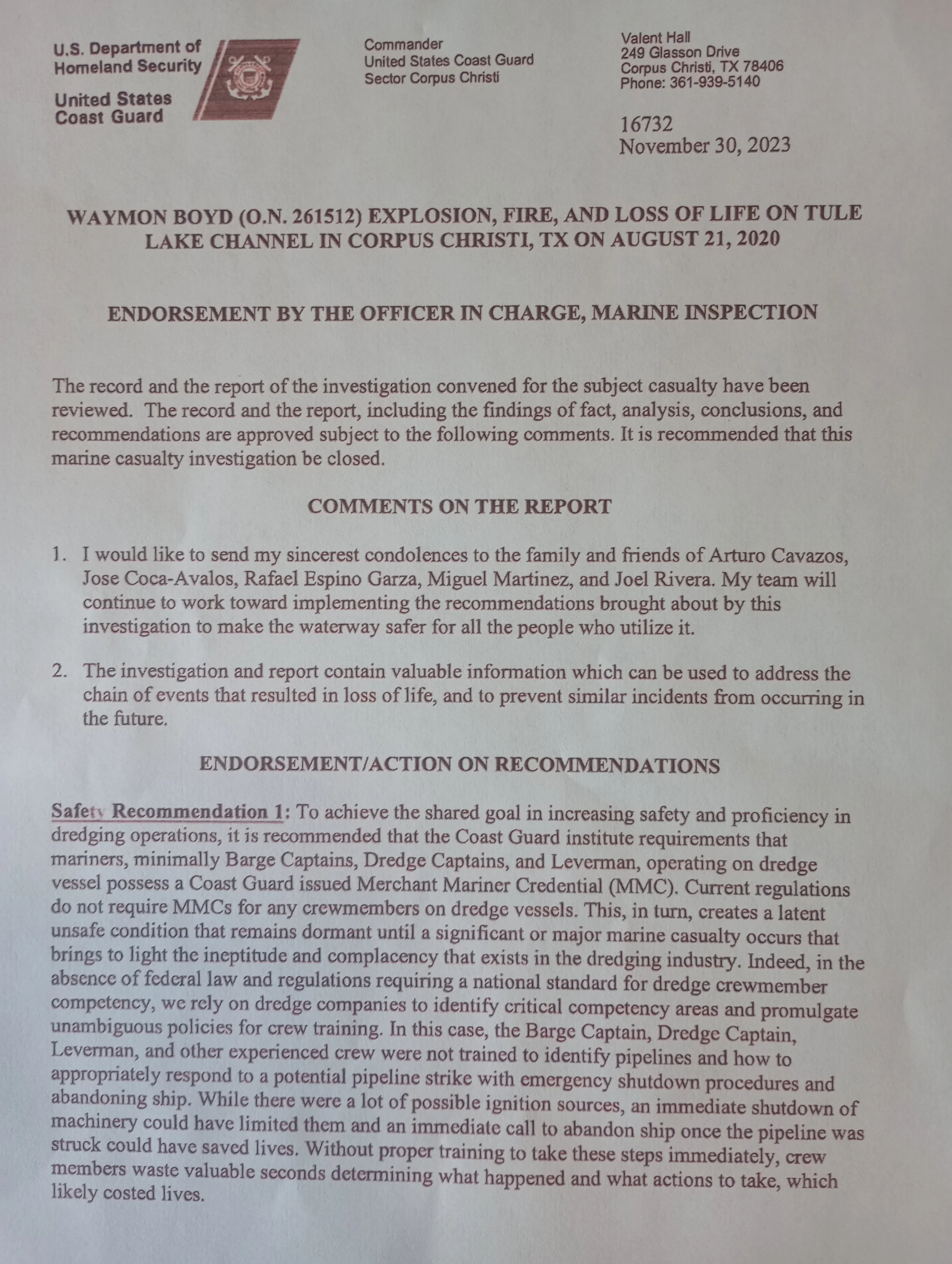
You can read the full report by clicking on the link above in References.
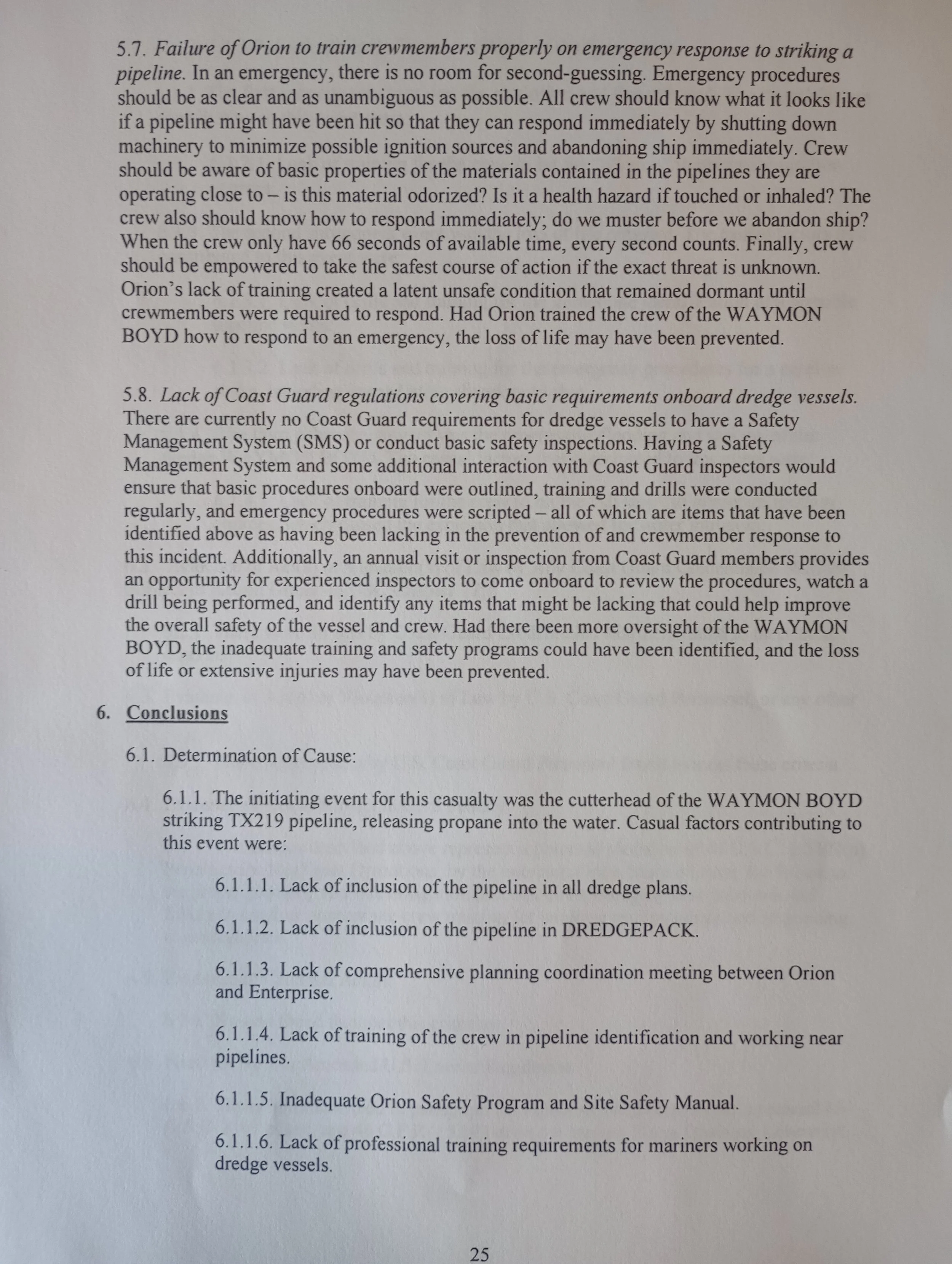
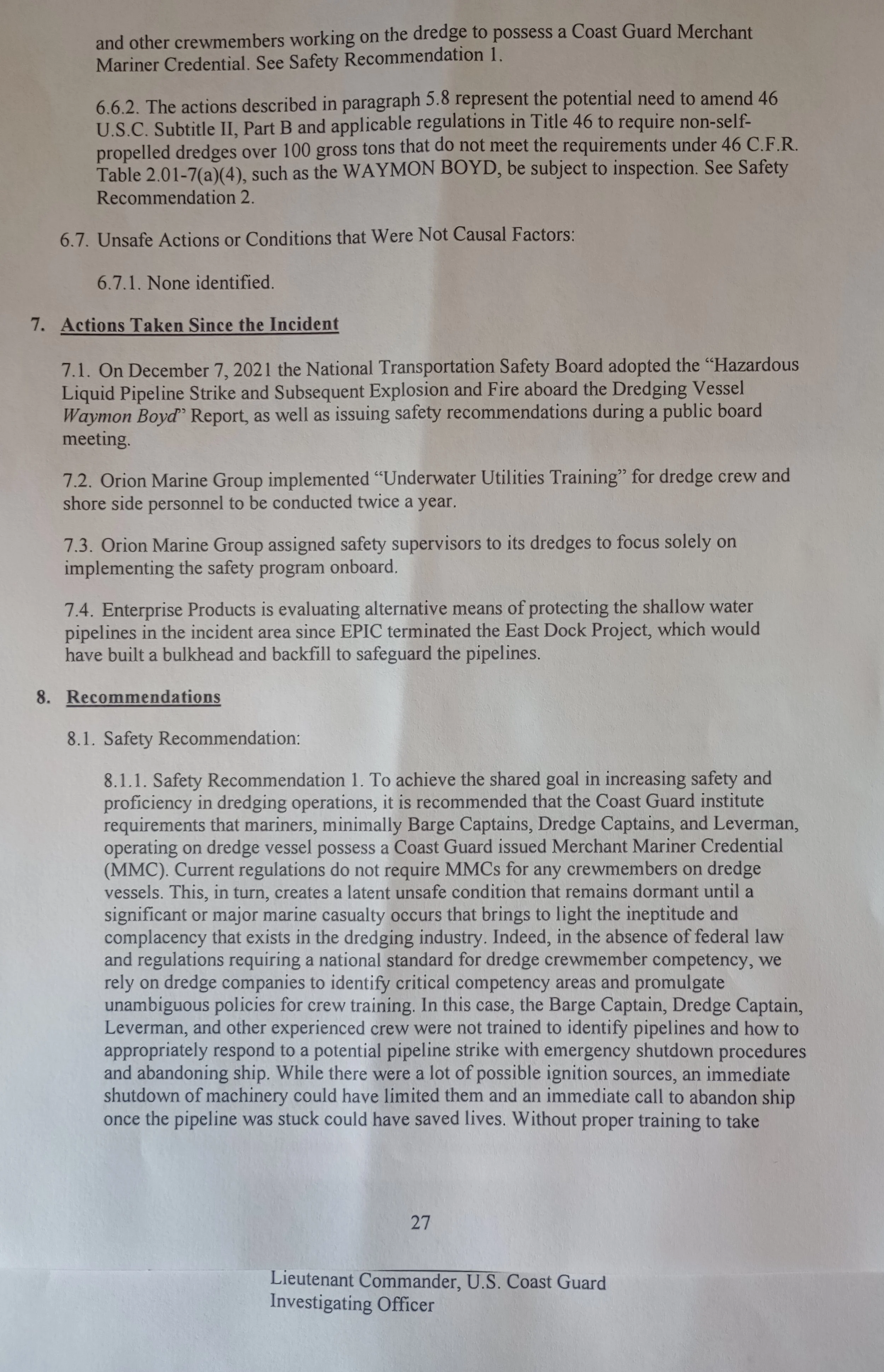
Official Source (Public Domain Federal Document)
United States Coast Guard – Marine Casualty Investigation
Report: WAYMONBOYD7039383ROIRedacted.pdf
Source: United States Coast Guard (.mil)
Direct Access Link:
https://share.google/UBSF01hAUkUr2GoLY
