Artificial Islands Deep Dive
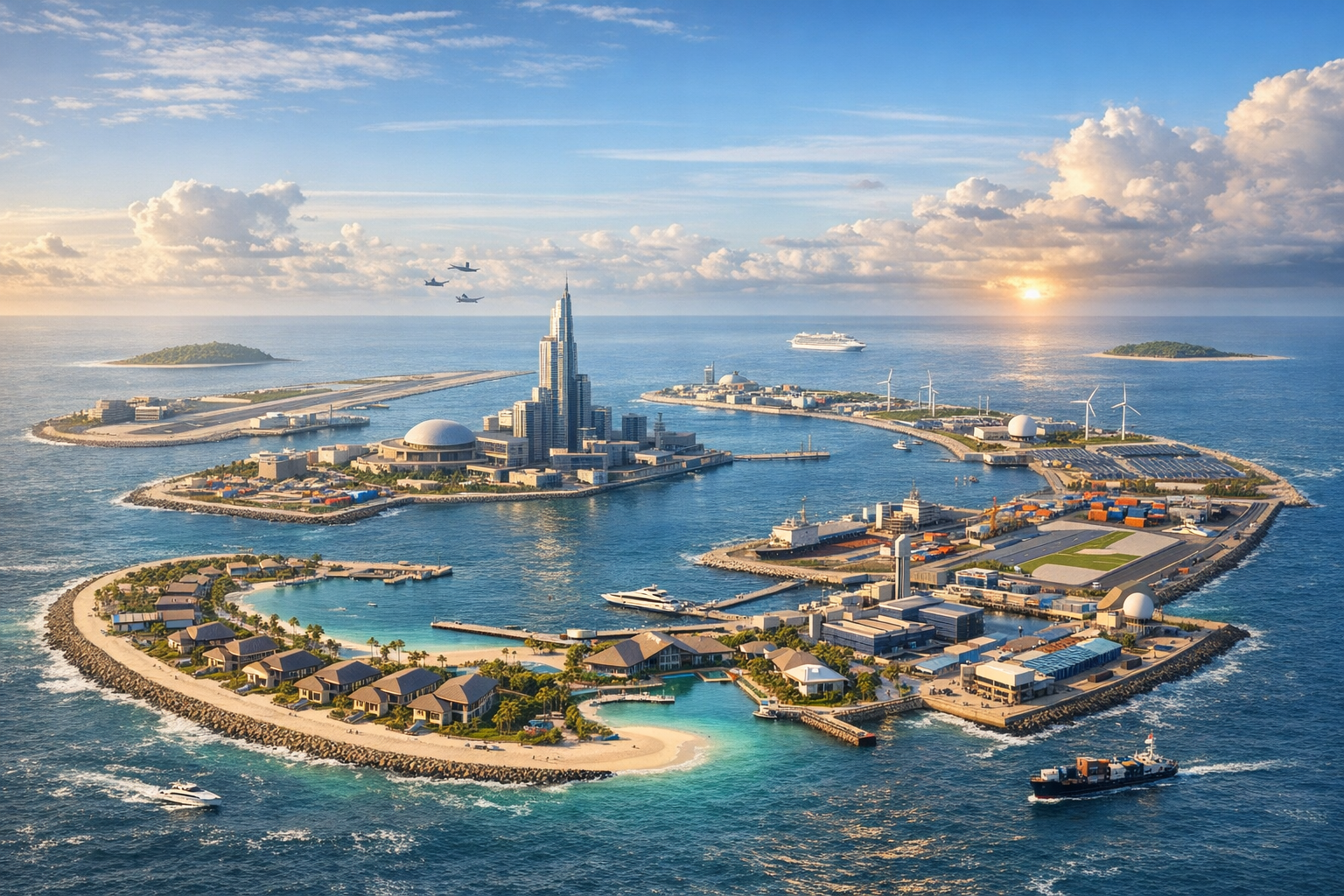
How Human-Made Islands Are Reshaping the Ocean and Why it Matters
Where the Story Begins, earlier this year I did an article under the Latest Oceanic News (I included in this section, below this article) section about Artificial Islands, I did more research and it goes a little deeper.
Artificial islands sound futuristic — new land rising from the sea, built grain by grain. But the ocean pays the price long before the first building goes up. Between 2013 and 2017, China created roughly 3,200 acres of new land in the South China Sea, while Vietnam added about 120 acres and Taiwan about 8 acres, almost all on or near coral reefs (McManus, 2020).
The First Wound: Dredging
To build an island, engineers use cutter suction dredgers and trailing hopper dredgers to rip sand, coral, and rock from the seafloor.
This process destroys coral instantly — reefs that took centuries to grow can be removed in minutes (Bruckner & Roberts, 2019).
The Cloud That Follows
Once the seafloor is torn up, a thick plume of sediment spreads like underwater smoke.
Satellite analysis of Mischief Reef showed that:
- Backscatter increased by up to 350%, meaning far more particles in the water
- Sediment plumes sometimes covered over 250 km²
- The cumulative area impacted exceeded 1,200 km² (NASA Earth Observatory, 2019)
These plumes:
- Block sunlight, starving corals and seagrass
- Smother coral polyps, burying them under fine sediment
- Reduce biological indicators like chlorophyll‑a, showing a decline in marine life (Bruckner & Roberts, 2019)
Even reefs not directly bulldozed still suffer.
Currents Change, Life Moves
When you reshape the ocean floor, you reshape the water itself.
Island‑building can:
- Alter local currents
- Destroy seagrass beds, which are nurseries and carbon sinks
- Fragment habitats, forcing species to move or decline (Vo & Hodgson, 1997)
The Human Layer
Most artificial islands aren’t built for homes or parks.
They’re built for military runways, ports, and strategic control — and the ocean becomes a casualty of human competition (McManus, 2020).
The Part We Forget
Sand isn’t limitless.
Every grain taken from the seafloor is a grain removed from a living system — a system that protects coastlines, feeds communities, and shelters thousands of species.
Globally, 19% of coral reefs are already lost, and 60–75% are under direct human pressure (Wilkinson, 2008).
Artificial islands add another layer of stress to ecosystems already pushed to the edge.
Why It Matters
Artificial islands don’t just change maps.
They change ecosystems.
They change coastlines.
They change the future of the ocean in ways we can’t undo.
And the ocean remembers every cut.
References
(All website links underlined for your site formatting.)
Bruckner, A. W., & Roberts, G. G. (2019). Impacts of dredging and land reclamation on coral reef ecosystems in the South China Sea. Marine Pollution Bulletin, 146, 681–695.
>https://doi.org/10.1016/j.marpolbul.2019.07.012</u>
Hughes, T. P., et al. (2017). Global warming and recurrent mass bleaching of corals. Nature, 543(7645), 373–377.
https://doi.org/10.1038/nature21707</u>
McManus, J. W. (2020). Offshore artificial islands and their ecological consequences. ICES Journal of Marine Science, 77(1), 1–12.
https://doi.org/10.1093/icesjms/fsz234</u>
NASA Earth Observatory. (2019). Sediment plumes from island‑building in the South China Sea.
https://earthobservatory.nasa.gov</u>
Vo, S. T., & Hodgson, G. (1997). Coral reef damage in Vietnam: A review of threats and management strategies. Ambio, 26(6), 358–365.
https://www.jstor.org/stable/4314647</u>
Wilkinson, C. (2008). Status of Coral Reefs of the World: 2008. Global Coral Reef Monitoring Network.
>https://gcrmn.net</u>
Analyst Perspective: Why These Developments Raise Legitimate Questions
When evaluating China’s expanding offshore infrastructure, it’s important to separate speculation from pattern recognition. No one outside the Chinese government can state its intentions with certainty — but analysts across marine policy, geopolitics, and environmental science consistently highlight several trends that make these megastructures worth public scrutiny.
1. Scale Beyond Scientific Necessity
Most nations conduct ocean research using ships, buoys, and temporary platforms. A 30‑story semi‑submersible facility capable of housing hundreds of people and supporting industrial‑grade equipment goes far beyond typical scientific needs (Futurism, 2026).
This doesn’t prove ulterior motives, but it does raise questions about dual‑use potential.
2. Alignment With Long‑Term National Goals
China has openly stated ambitions to become a global leader in:
- deep‑sea resource extraction
- offshore energy
- marine technology
- food security through distant‑water fishing
These platforms directly support those goals. Their capabilities match China’s broader strategic timeline, especially the push toward 2030 as a milestone for ocean resource development (CCTV, 2026).
3. A Documented Pattern of Civilian‑to‑Strategic Transition
Artificial islands in the South China Sea were initially framed as civilian research and tourism projects. Over time, they became militarized with runways, radar systems, and missile platforms.
This history makes analysts cautious when new “research” structures appear with similar strategic advantages.
4. Persistent Presence Without Legal Territory
Under international law, artificial islands and floating platforms do not create territorial waters.
But in practice, a nation that maintains a continuous presence in a region gains:
- influence
- monitoring capability
- logistical advantage
- de facto control
This is a subtle but powerful form of expansion that avoids legal conflict.
5. Environmental and Resource Pressures
China’s domestic waters face severe overfishing, and its industries require massive quantities of nickel, cobalt, and manganese — the same metals found in polymetallic nodules (Hardware Busters, 2026).
Platforms capable of deep‑sea operations naturally raise concerns about future extraction, even if the stated purpose is scientific.
