The Girl Who Found a Megalodon Tooth
When you’re eight years old, you don’t expect to find something older than every road, every house, and every grown‑up you know. But that’s exactly what happened to Molly Sampson on Christmas morning in Maryland, where she was fossil hunting with her family along the shoreline of the Chesapeake Bay.
The beach she explored sits below the Calvert Cliffs, a stretch of eroding Miocene‑era sediment that releases ancient marine fossils after storms and shifting tides. Most kids go there hoping to find small shark teeth — the kind you can collect by the handful. That’s all Molly expected too.
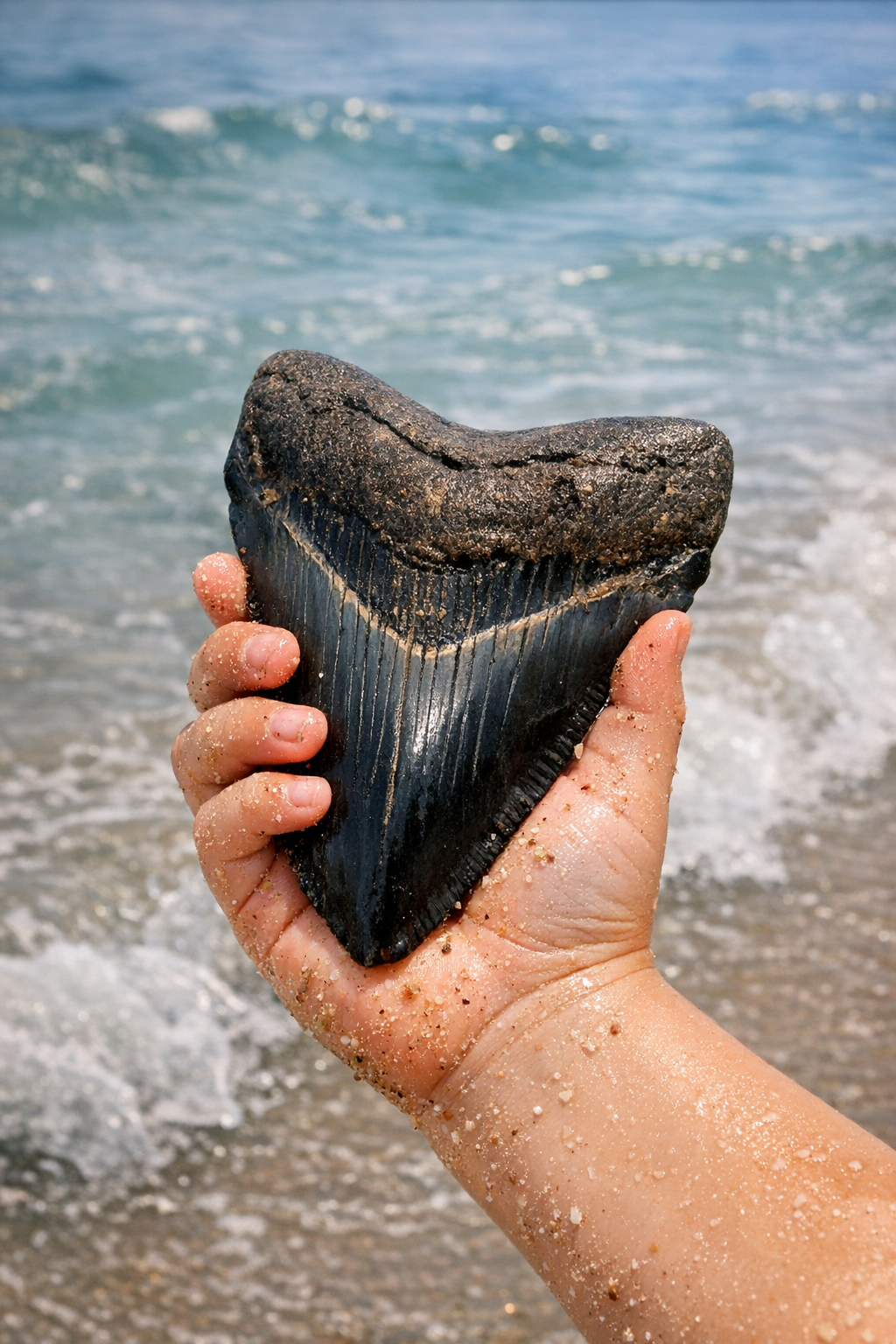
Then she reached into the cold water and pulled out something heavy. A megalodon tooth.
It measured about five inches long, and scientists at the Calvert Marine Museum later confirmed it came from Otodus megalodon, the largest shark to ever live. The tooth was likely between 10 and 15 million years old, preserved in the same cliffs that once formed the floor of an ancient sea.
Megalodons were giants of the Miocene oceans, reaching 50 to 60 feet in length — longer than a school bus. Their teeth could grow up to seven inches, with serrated edges built for hunting whales and large marine mammals. They lived between 23 and 3.6 million years ago, disappearing as ocean temperatures cooled and prey species declined.
Molly didn’t know all of that when she found her tooth. She didn’t know she was holding a piece of a predator that once ruled the ocean. She didn’t know the cliffs behind her were famous for releasing fossils older than human history.
.Grown‑ups everywhere were amazed. Scientists praised her find. News outlets shared her story.
But Molly simply smiled and said she hoped to find an even bigger one next time.
Kids don’t see limits the way adults do. They don’t worry about what’s too rare or too old or too impossible. They just explore. They follow curiosity wherever it leads.
And maybe that’s the real lesson.
The ocean still has secrets — but sometimes it takes a kid to find them.
References
"https://www.calvertmarinemuseum.com" style="text-decoration: underline;">Calvert Marine Museum. (2022). Information on the identification and verification of Molly Sampson’s megalodon tooth.
"https://www.nps.gov/articles/calvert-cliffs-fossils.htm" style="text-decoration: underline;">National Park Service – Calvert Cliffs Fossils</a>. Geological overview of the Miocene formations where shark teeth are commonly found.
"https://naturalhistory.si.edu/education/teaching-resources/paleontology/megalodon" style="text-decoration: underline;">Smithsonian National Museum of Natural History – Megalodon</a>. Species profile including size, diet, and extinction timeline.
"https://journals.plos.org/plosone/article?id=10.1371/journal.pone.0134851" style="text-decoration: underline;">Pimiento & Balk (2015), PLOS . Research on megalodon body size and ecological role.
"https://www.floridamuseum.ufl.edu/sharks/megalodon/" style="text-decoration: underline;">Florida Museum of Natural History – Megalodon</a>. Educational resources on fossil distribution and shark evolution.
